Review diagnostic mistakes
Target weak question type
Save new words
Locked
EAEnglishAll-in-One
English All-in-One
IELTS, SAT and English exam practice
IELTS, SAT, Abituriyent, Magistr, state exams and language courses — one engine, one progress record.
Four-skill diagnostics · Cambridge reading and listening papers · teacher tools
What is your goal?
One question, three answers — not a list of eight products.
Go abroad
Languages
General EnglishA0 → C1: vocabulary, grammar, skillslive
RussianA0 → B2: vocabulary, grammar, skillslive
Other languagesSame engine, new content packsplanned
The GE course engine — units, review tests, flashcards — is reusable. A new language is content, not a rebuild.
Azərbaycanda İmtahanlar
AbituriyentBachelor's admission examlive
MagistrMaster's programme admissionlive
State examsCivil service and other state examsplanned
Content not loaded
Loading content…
Open modules
Local preview (localhost)
Preview URL: http://localhost:8000 (run ./scripts/serve-local.sh if the page does not load).
This address keeps its own browser storage. Progress from your live site (diagnostic completion, plan unlock, practice bands) does not appear here automatically.
Sign in with the same account for cloud dashboard counts. To test the full plan flow locally, complete the diagnostic on this origin.
If the page looks stale, hard-refresh (Safari: Option–Reload) or clear cache for this origin.
Diagnostic Test
Find out your current level and improve step by step. All four sections are free.
1
🎧
Listening
FREE
Full Listening Paper (Approx. 30 min)
2
📖
Reading
FREE
Academic Reading Paper (60 min)
3
✏️
Writing
FREE
Two Writing Tasks (60 min)
4
🎤
Speaking
FREE
Speaking Simulation (Approx. 15 min)
Daily Study Plan
Complete the diagnostic test first to unlock your personalised daily plan.
Teacher mode: run the full diagnostic on this device, open saved results (same browser storage as students), or preview study-plan options for a sample overall band (Listening + Reading + Writing mean; Speaking not included).
Listening accuracy drills
Writing task practice
Check common errors
Locked
Your Diagnostic Results
Completed all 4 sections — here's how you did.
Welcome back! 👋
Track your progress and keep preparing for your best score.
🖥
Stored on this device only.
📘
New words
0
added this period
✓
Flashcards
—
self-checks
📊
Flashcard activity
— total words
— reviewed (≥1)
— mastered
— review actions
— correct answers
📄
Reading tests
—
submitted
🎧
Listening tests
—
submitted
✏️
Writing tasks
—
submitted
🎤
Speaking
—
sessions
Recommended for you
Loading suggestions…
📘 Flashcards overview
Word library & checks
🔥
Streak
Keep practising daily
📄 Reading
Loading…
🎧 Listening
Loading…
✏️ Writing
Loading…
🎤 Speaking
Loading…
Your Progress Overview
Reading
Avg. Band
—
0 tests
Listening
Avg. Band
—
0 tests
Writing
Avg. Band
—
0 tasks
Speaking
Avg. Band
—
0 sessions
— total time
Last: —
In range: — sessions
Recent attempts
Sparklines show band scores for attempts in the selected range.
💡
Tip of the day: Review wrong answers from your last reading or listening attempt — patterns repeat.
ⓘ
Counts use saved attempt history (including retakes). Each list row is one submission (score, band, time). Reading adds Cambridge vs Exclusive mix when papers resolve from your library. Vocabulary uses words saved to Flashcards from Reading. Listening plays once during the test; after submit, audio is pausable for review.
Cambridge-style Reading (Full Tests)
3 passages • 40 questions • 60 minutes
Showing 0 tests
No tests match your filters.
Online IELTS Reading — Choose a Collection
Browse Cambridge papers and exclusive practice packs. Each full test has three passages and 40 questions, with timer and authentic layout.
Reading tests
0completed
Avg. band —
Listening tests
0completed
Avg. band —
Overall avg. band
—
Last activity
—
Cambridge 1–9
The older Cambridge papers — timed, authentic layout.
— tests available
Cambridge 10–21
The recent Cambridge papers — closest to the current exam.
— tests available
Exclusive Tests
Practice papers from our exclusive packs—same timed layout as the Cambridge-style tests.
— tests available
General Training
General Training format tests — everyday and workplace texts, same timed layout.
— tests available
Recent activity
Recommended for you
All tests
Online IELTS Listening — Choose a Collection
Browse Cambridge listening papers and exclusive packs. Each full test has four sections. Official-style tests use timed audio in the runner; exclusive packs may include custom recordings.
Listening tests
0completed
Avg. band —
Reading tests
0completed
Avg. band —
Overall avg. band
—
Last activity
—
Cambridge Tests
Official-style Cambridge Listening tests — timed runner with audio + review.
— tests available
Exclusive Tests
Exclusive Listening packs (custom MP3 + transcript). Questions can be added later.
— tests available
All tests
Progress
Your completed practice and scores will appear here. Complete a module from the dashboard to start tracking.
Practice history
Profile
Account and preferences can be managed here. This simulator runs locally in your browser for practice.
About
This platform is run by a certified IELTS examiner who holds an IELTS certificate with an overall band score of 8.5 (Writing 8.0) and has around 10 years of experience teaching General English, IELTS, GRE, and SAT.
This website is designed to support both students and teachers. Students can practice IELTS-style tasks, while teachers can follow their students’ progress. If you would like to register as a teacher, please use the form.
Our students have consistently achieved strong results in their exams. You can see examples on our Facebook and Instagram pages.
Premium is a one-time payment for 1, 3, 6, or 12 months (or a short 7-day trial) — not a monthly subscription. You can upgrade anytime; if you still have days left, they are added to your new plan. See and , or use Become Premium in the sidebar.
Privacy policy
Last updated: 12 May 2026
Overview
This policy describes how personal information is handled when you use “Orkhan's English”, our IELTS preparation platform. We aim to explain clearly what may be collected, why it is used, and how it may be shared.
Information we may collect
- Account details: for example, the email address you provide when you sign up, and your name if you choose to share it.
- Learning activity: such as test results, essay drafts or submissions, reading and listening history, and similar practice data — mainly to run the service and show you progress.
- Technical data: such as browser type, approximate time zone, and anonymised or minimally identifying logs for reliability and security (where applicable).
How we use information
We process this information to operate your account, verify Premium status and payments (where applicable), support teacher–student features, keep the platform secure, and improve the learning experience.
Storage and security
We take reasonable technical and organisational steps to protect data against unauthorised access, alteration, or disclosure. No method of transmission over the internet is completely secure, but we work to safeguard your information.
Third parties
Hosting, authentication, analytics, or payment processing (where used) may be provided by trusted suppliers. Those suppliers have their own privacy terms and should only receive data needed to deliver their service.
Cookies and device storage
We may use cookies, local storage, or similar technologies so the site can function (for example, keeping you signed in) and to remember preferences. You can limit this in your browser settings; some features may not work fully if you do.
Your rights
To ask about access, correction, deletion, or objection to processing of your personal data, please reach us via the options on the page. Additional rights may apply depending on the laws in your country.
Changes
We may update this policy from time to time. If changes are significant, we will try to notify you on the site. Please review this page occasionally for the latest version.
Refund policy
Last updated: 22 June 2026
Non-refundable payments
Because we offer free diagnostic tools, limited free AI checks, and other trial features before you pay, all Premium payments are non-refundable. Please try the free features thoroughly before upgrading.
One-time payments
Premium plans are one-time payments for the duration you choose (1, 3, 6, or 12 months, or a 7-day trial). We do not charge your card automatically again. When your plan ends, you can buy another plan if you wish to continue.
Upgrades
You may purchase a longer plan at any time. If you still have active days on your current plan, the remaining time is added to the new plan. Contact us on if your account does not update after payment.
Payment issues
If you paid but Premium did not activate, use the form with your payment email and we will help within 24 hours (priority support for 12-month plans).
Terms of use
Last updated: 22 June 2026
Premium access
Premium unlocks paid features for the period shown at checkout. IELTS Premium and General English Premium are separate products unless stated otherwise.
Devices
You may stay signed in on up to two devices at the same time (for example, a laptop and a phone). Signing in on a third device signs out the oldest session automatically.
Account sharing
You may share your login with one study partner if you wish, but progress, AI history, and device limits apply to the whole account. Sharing may cause unexpected sign-outs if more than two devices are used.
Support
We aim to reply to all messages within 24 hours via . 12-month Premium includes priority support (faster response when possible).
No score guarantee
We provide practice tools and AI feedback to help your preparation. We cannot guarantee a particular IELTS band score or exam result.
See also our and .
Contact
Get in touch for Premium membership, teacher registration, or general questions.
Send us a message below — we reply by email, usually within 24 hours. 12-month Premium plans receive priority support.
Social media
The same links appear in the sidebar.
Writing
Practice timed tasks and get better every day.
Your essay
Draft
Paste detected
40:00
Words: 0
Task 2 requires an essay of at least 250 words. Plan → Write → Review → Submit for feedback.
Topic
Essay type
Topic Image
or click inside and press Ctrl/Cmd+V to paste
Writing — Study Library
To completely understand these structures, it is best to read sample essays by a certified Band 8.5+ examiner.
Task 1 — Note 1
Patterns, grammar, pie-chart language, following / followed by.
Task 1 — Note 2
Openings, overalls, examples by chart type, maps, processes.
Task 1 (GT) — Letters
Structure, register, salutations, useful phrases, model letter.
Task 2 — Balanced essays
When a balanced approach works: opinion, discussion, +/−, outweigh.
Task 2 — No opinion & other types
Advantages vs disadvantages (no outweigh), problem–solution.
Sample essays by a certified Band 8.5+ examiner (writing 8.5 and 9.0)
Band 8.5 and 9.0 model answers · Task 1 includes visuals · copying disabled in the viewer
Official writing score: 8.0
Preview: 1× Task 1 & 1× Task 2 (free) · full library = Premium
Viewer
Copying is disabled in this viewer.
My Essays
All your submitted essays and AI feedback (from your account).
Essay
Task 1 — Note 1
Jump between topics with the tabs — each section scrolls on its own.
General Task 1 structure
Everything in these notes can be used across different Task 1 formula patterns.
General Task 1 structure
Introduction: Paraphrase the given title in your own words and mention the units, for example: “Units are measured in millions of dollars.”
Overall: Describe the general trend in the visual: which categories increased or decreased, and which categories were highest or lowest at the beginning and end of the period. You may mention years, but do not include exact figures in the overall.
Body 1: Discuss categories with similar trends.
Body 2: Discuss the different trend. Alternatively, Body 1 can cover maximum/minimum figures and Body 2 can cover middle-range figures.
Remember: there is no single fixed structure for grouping Body 1 and Body 2. You choose the grouping based on the chart.
Model report — Band 8.5+ (4-part structure, line graph)
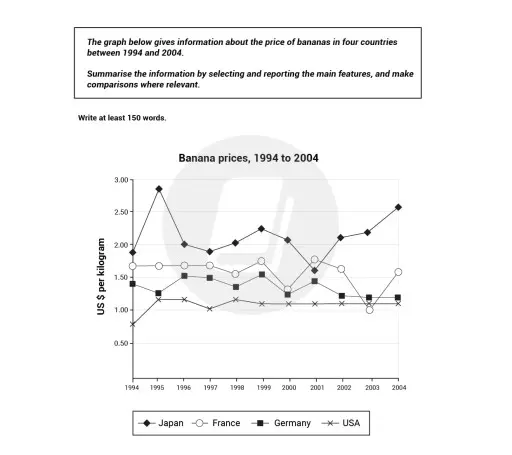
Topic: Banana prices in Japan, France, Germany and the USA (1994–2004).
Introduction — paraphrase what the visual shows
The line graph compares how banana prices in Japan, France, Germany and the USA changed from 1994 to 2004, measured in US dollars per kilogram.
Overview — big picture, no exact numbers
Overall, except in the USA, prices fluctuated markedly throughout most of the time frame. While Japan consistently dominated the list, the reverse was true for the USA.
Body 1 — detailed data (USA vs Japan contrast)
In detail, starting at about 0.8 dollars, banana prices rose to over 1.0 dollars in 1995. Except for small variations exceeding $1.0, the number for the USA remained close to 1.0 for the remainder of the period. By contrast, in Japan, bananas were much more expensive, sold at just under 2 dollars in 1994. In the following year, the price rose sharply to well below 3.0 dollars before dropping to 2.0 dollars the following year. After mild fluctuations between 1997 and 2000, it fell to approximately 1.6 dollars. However, by the end of the period, the figure had reached over 2.6 dollars.
Body 2 — remaining categories (France & Germany)
France and Germany exhibited similar patterns: the numbers for both were volatile, ranging from $1.2 to $1.7. After hitting a low point of approximately $1.2 in 2000, their trajectories diverged: banana prices in France did not change significantly, hovering above $1.0, whereas prices in Germany varied widely, dropping to just under $1.0 in 2003 before recovering to over $2.0 in 2004.
Why this report is Band 8.5 / 9.0
- All four parts present: Intro → Overview → Body 1 → Body 2 — matches your general Task 1 structure above.
- Overview selects features: Highest (Japan), lowest (USA), general trend (fluctuation) — without listing every figure.
- Logical grouping: Body 1 contrasts extremes (USA low vs Japan high). Body 2 covers the middle pair together.
- Comparison language: By contrast / whereas / while — essential for Band 8+ Task 1.
How each paragraph starts (Task 1 — any chart)
- Intro: The [chart type] compares / illustrates / shows…
- Overview: Overall, + main trend + highest/lowest or exception
- Body 1: In detail, or Regarding X, + figures + comparisons
- Body 2: As for / Turning to / France and Germany… + remaining key data
Notes 1–3 — vocabulary patterns
Note 1:
A/an + dramatic/ sharp/ enormous/ steep/ substantial/ considerable/ significant/ rapid/ moderate/ gradual/ slight/ marginal/ minimal + increase/ decrease
Note 2:
Sth+ dramatically/ enormously... + increased/ decreased...
Note 3:
You can use the following structures to transition to Body 2:
As for / regarding / in regard to / turning to / when it comes to + something, + sentence
For ex: As for the feature in the city that has seen few developments, the shop to the south has been left intact.
Practice translation: As for the number of students in Shamkir, it increased.
Describing change & figures
Use the groups below. Each box shows the pattern (yellow) first, then a model sentence you can copy.
1. Final figure + amount of change
Something increased to / decreased to + figure, a rise / increase / decrease / fall of + figure.
The number of students increased to 30, a rise of 10. (From 20 → 30, so the change was 10 units.)
The number of cars owned by Alex decreased to 3, a fall of 10 units.
2. “There is / was” + noun phrase
There is / was + an increase / a decrease / a fall / a rise / a boom / growth / a climb + of + figure + in + something, from + figure + to + figure.
There was a drop of 50% in the proportion of students who read books, from 70% to 20%.
3. Peaks & highs
Peak at / reach a peak of / reach its (or their) peak at + figure.
Increase / climb / rise / surge to a high of + figure.
It increased to a high of 70% — the maximum point.
4. Lows
Reach a low of / drop / decrease / fall / plunge / plummet to a low of + figure.
The number of students fell to a low of 5.
5. From low → high / high → low
Rise / increase from a low of + figure to a high of + figure.
The number of students rose from a low of 5 to a high of 75.
Decrease / fall from a high of + figure to a low of + figure.
The number of students fell from a high of 75 to a low of 5.
6. Witnessed / experienced / saw
Something showed / witnessed / experienced / saw + a decrease / fall / increase + of + figure, from + figure + to + figure.
The number of students witnessed an increase of 20%, from 10% to 30%.
A reduction / increase of + figure was witnessed / experienced / recorded in + something, from + figure + to + figure.
7. Starting figure
At the start / beginning of the period, or initially, something stood at + figure.
Initially, the proportion of the old stood at 20%.
8. “To” vs “by” — do not mix these up
To = final position → increase / decrease to + figure.
It increased (from 10%) to 30%.
By = amount of change → increase / decrease by + figure.
It increased by 30% (from 40% to 70%).
“To” = where it ended. “By” = how much it moved.
9. No change / plateau
Something remained steady / unchanged / stable / constant at + figure.
Something levelled out / reached a plateau / plateaued / levelled off / did not change / maintained the same level / stood steady at + figure.
10. Fluctuation
Something fluctuated / oscillated / was volatile between + figure and + figure.
A fluctuation / oscillation / a period of volatility was witnessed / experienced / recorded / seen in + something.
Fluctuations (between 10 and 20) were seen in the number of students from Shamkir.
11. Had a climb / decrease of
Something had a climb / decrease of + figure.
Following / before / after / gerund
Extra:
How to use “Following and followed by”
Sth happens, following sth2 (this happens first)
Here, the action described in “something 2” happens before “something”.
Note: following + noun phrase / object + gerund.
Example: He died, following his wife’s death.
Here, his wife died first.
“sth”happens, followed by “sth2”
Here, the action described in “something” happens first.
Example: She died, followed by her husband’s death.
Here, the woman died first again.
Example of use in IELTS:
The number of students dramatically increased by 100, following a sharp decrease of 70.
Here, the decrease happened first.
The number of students experienced a sharp increase of 100, followed by a dramatic decrease of 70.
Here, by contrast, the increase happened first.
Sth happens before sth else happens
I sold my car before I sold my house ( First, I sold my car. Then, I sold my house)
Before=after which
I sold my car after which I sold my house
Sth happens after sth else happens
I sold my house after I sold my car
After=before which
I sold my house before which I sold my car
Gerund
I sold my car before selling my house
I sold my house after selling my car
I sold my car before you sold your house – in this sentence- we cannot use -before selling-because -the subject after the word “before” is different
I killed her before I buried her
Who did the killing?-I
Who did the burying-I So it means I can use a gerund, because both actions are done by the same person
I killed her before burying her.
Passive Voice (with gerund)
My car was sold before (after which) my house was sold
My house was sold after (before which) my car was sold
Passive Voice (with Gerund)- subjects of both parts should be the same
He was beaten before he was arrested--- He was beaten before being arrested
He was arrested after he was beaten- He was arrested after being beaten.
Pie chart
PIE chart
Contribute to=make up=to be composed of=constitute=comprise=to be comprised of=consist of=account for
Make up
Small unit+make up/contribute to/constitute/comprise/account for+ %+of+big unit
Ex: Boys make up 20% of the class.\/////// Boys contribute to 20% of the class.
Make up- Passive Voice
%+of+Big unit+to be+made up of/comprised of/composed of+small unit
Ex: 20% of the class is made up of boys.
Note: %+of+big unit+consist of+small unit
20% of the class consists of boys.
Common vocabulary for PIE CHART
Generate/produce/create/engender
Cause/bring about/lead to/pave the way for
Note: because pie-chart categories are usually given as percentages, use:
the proportion / the rate / the percentage / the amount / the quantity + of + something.
The proportion of people who had a computer decreased in 2005.
Model report — Band 8.5+ (pie chart)
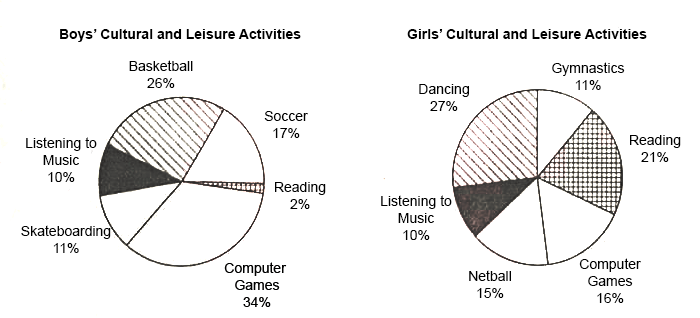
Topic: Children’s leisure pursuits by gender (pie charts).
Introduction
The pie charts illustrate the outcome of a survey into children’s leisure pursuits, categorised by gender.
Overview
Overall, boys and girls differ widely in their preferences, with only three common interests: listening to music, playing computer games and reading. While boys favour computer games, girls mainly lean towards dancing.
Body 1 — shared activities + contrast
In detail, although both boys and girls are engaged in computer games, computers are by far the most popular with boys, at 34% compared to 16% of girls. In contrast, the gap between them reverses in reading, which attracts over one-fifth of girls as opposed to merely 2% of boys. Listening to music is equally preferred, with the numbers for both girls and boys standing at 10%.
Body 2 — gender-specific activities
However, pronounced gender-based differences are observed in the remaining activities. Basketball is popular among just over a quarter of boys, making it the second most prominent activity for boys, followed by soccer at 17%. Skateboarding represents only 11%. Among girls, dancing accounts for the largest share, at 27%, compared with 11% for gymnastics. Finally, reading and netball constitute 21% and 15% of the total, respectively.
Why this report is Band 8.5 / 9.0
- Pie-chart grammar: Uses the proportion of / at 34% / accounts for the largest share — not “computer games was 34%.”
- Overview names categories: Largest for each gender (games vs dancing) plus shared interests — no number overload in overview.
- Grouping: Body 1 = overlap + direct boy/girl contrast. Body 2 = activities unique to each gender.
Task 1 — Note 2
Pick a chart type — each tab keeps the scroll short.
The 4-part Task 1 answer
1. Introduction: Paraphrase the question in one sentence. Say what the visual shows, the place or group if given, and the time period if given.
Useful opener: The chart compares / illustrates / shows + what + where + when.
Example: The bar chart compares the percentage of adults using public transport in four countries between 2000 and 2020.
2. Overview: Give the big picture. This is the most important paragraph. Do not include exact numbers here.
Ask yourself: What increased? What decreased? What was highest or lowest? Was there any exception?
3. Body 1: Group the most important similar data. Use exact figures and comparisons.
4. Body 2: Cover the remaining key data, exceptions, or a second logical group.
Do not: give opinions, explain reasons not shown in the visual, describe every number, or write bullet points.
Line graphs & bar charts
Step 1: Identify whether the data changes over time. If it does, focus on trends: increases, decreases, fluctuations, peaks, and final positions.
Step 2: Choose the main features. Usually these are the highest figure, lowest figure, biggest rise or fall, and any unusual exception.
Step 3: Group logically. Do not simply describe category A, then B, then C. Pair items with similar movements or clear contrasts.
Good grouping examples: rising categories together; falling categories together; high figures in one body paragraph and low figures in the other.
Useful language: rose steadily, increased sharply, declined slightly, remained stable, fluctuated, reached a peak, fell to a low.
Overview model: Overall, most categories increased over the period, while only one showed a decline. The highest figure was recorded by X, whereas Y remained the lowest throughout.
Model report — Band 8.5+ (line graph)
Topic: Banana prices in four countries, 1994–2004. (Full 4-part version also in Note 1 → Structure.)
Overview — trends without numbers
Overall, except in the USA, prices fluctuated markedly. While Japan consistently recorded the highest prices, the reverse was true for the USA.
Body — contrast + trend verbs
By contrast, in Japan, prices rose sharply before dropping again, whereas the USA figure remained stable at around $1.0. France and Germany exhibited similar patterns, though their trajectories diverged after 2000.
Key line/bar language (highlighted)
- Trends: rose steadily / increased sharply / declined / remained stable / fluctuated / reached a peak
- Compare: By contrast / whereas / while
- Group: pair countries with similar patterns; split high vs low across body paragraphs
Pie charts & tables
Pie charts: Focus on proportions. Identify the largest share, the smallest share, and any categories with similar percentages.
Better wording: Do not write “Joining family was 13%.” Write “The proportion of people who moved to join family was 13%.”
Useful language: accounted for, made up, represented, constituted, comprised, the largest share, a small minority.
Tables: Scan rows and columns for patterns. Look for the highest and lowest values, repeated patterns, and clear differences between groups.
Table grouping: Body 1 can describe the strongest and weakest groups. Body 2 can describe middle figures, exceptions, or remaining categories.
Overview model: Overall, the figures were broadly similar across most categories, although X recorded the highest values while Y was generally the lowest.
Model report — Band 8.5+ (table)
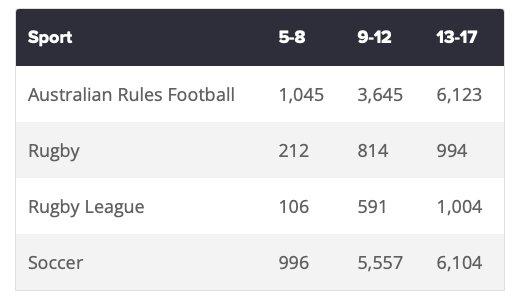
Topic: Junior football players by age group and sport type (Australian city, 2015). (Pie chart model in Note 1 → Pie chart.)
Introduction
The table illustrates how many juniors, by age group, played in 4 forms of football in an Australian city in 2015.
Overview
Overall, the 13–17 age group recorded the highest participation, with a substantial gap in almost all football games, though the difference was narrower in Rugby. Except for 9–12-year-olds who showed a greater preference for Soccer, children and teenagers mostly played Australian Rules Football.
Body 1 — dominant sport + exception
In detail, Australian Rules Football registered the highest number of players: 1,045 players were 5–8, while the number for the 9–12 age group was more than three times as high, at 3,645, which climbed to as high as 6,123 among those aged 13–17. Although Soccer players aged 5–8 and 13–17 accounted for smaller numbers, at 996 and 6,104, respectively, a higher number of 9–12-year-olds engaged in Soccer (5,557).
Body 2 — remaining rows / reversal
In the 5–8 age group, Rugby attracted 212 players, whereas Rugby League accounted for just 106. This gap widened in the 9–12 age group, with 814 juniors engaging in Rugby, compared to 591 in Rugby League. However, moving on to the older age groups, the difference in figures reversed, with teenage Rugby League players (1,004) exceeding Rugby by just 10 players.
Why this table scores Band 8.5 / 9.0
- Reads rows & columns: Spots the 13–17 peak and the Soccer exception at ages 9–12 — not a random list of cells.
- Comparison across age groups: more than three times as high / whereas / however… reversed
- Table openers: In the 5–8 age group… / However, moving on to the older age groups…
Mixed charts
Mixed charts contain two visuals, for example a bar chart and a pie chart. Your job is to connect the main message instead of treating the visuals as two unrelated tasks.
Introduction: Mention both visuals in one sentence.
Overview: Give one main point from each visual, or show how the two visuals are connected.
Body 1: Describe the first visual with the most important figures.
Body 2: Describe the second visual and make a comparison with the first if possible.
Useful sentence: While the first chart shows differences by age group, the second chart focuses on the composition of the same group by household type.
Model report — Band 8.5+ (mixed: bar + pie)
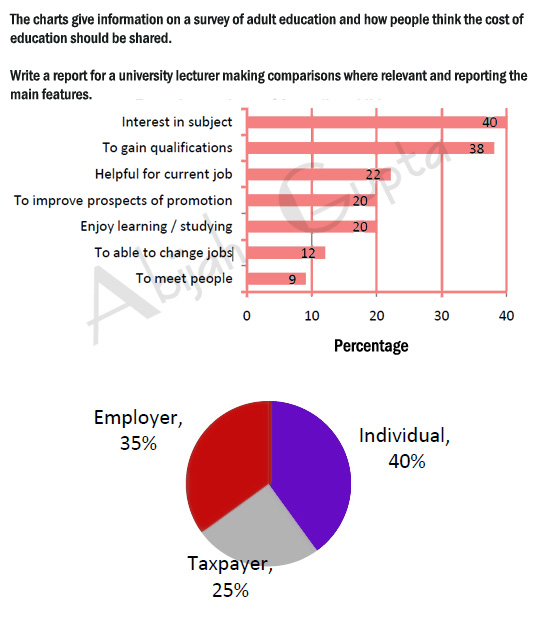
Topic: Reasons adults return to education, and who should pay for it (bar chart + pie chart).
Introduction — name both visuals in one sentence
The bar chart illustrates the outcome of a survey regarding why adults pursue education. The pie chart depicts people’s perspectives on how adult education should be financed.
Overview — one main point from each visual
Overall, interest in the subject and the desire to gain qualifications are the most prevalent motivators in adult education, whereas meeting new people accounts for the smallest share. Funding is mostly believed to be the individual’s responsibility.
Body 1 — first visual (bar chart) with the key figures
In detail, passion for a subject is the main reason for education, at 40%, closely followed by the objective to obtain qualifications, at 38%. On the contrary, less than one-tenth of people go on to university to meet new people, making it the least significant factor. A comparable share of individuals (12%) cite the opportunity to change jobs as their reason to study. The chances of promotion, assistance in the current job and enjoyment from learning/studying contribute similar proportions, ranging from 20% to 22%.
Body 2 — second visual (pie chart), connected back to Body 1
Turning to views on cost-sharing, the largest share of respondents (40%) believe that individuals themselves should be responsible for the cost of education. Around a third consider that employers should take the responsibility for the costs. Only a quarter of the survey participants claim that taxpayers should cover the costs.
Mixed-chart paragraph openers
- Introduction: The bar chart illustrates… The pie chart depicts… — one sentence per visual, not one long sentence trying to cover both
- Moving to the second visual: Turning to… / As for… / Regarding…
- Every figure in Body 1 and Body 2 is stated once — no listing every category, group ones that share a similar value
Maps & processes
Maps: Identify what changed, what stayed the same, and where the biggest changes happened. Use location language: to the north, in the centre, on the western side, next to, opposite.
Map overview model: Overall, the area was significantly redeveloped, with new facilities added in the centre, while the northern section remained largely unchanged.
Future map language: is expected to, is planned to, is projected to, will be replaced by, will be converted into.
Processes: Count the stages, identify the first and final stages, and state whether the process is linear, cyclical, natural, or man-made.
Process overview model: Overall, the process consists of six main stages, beginning with raw material collection and ending with the final product being packaged.
Process grammar: Use passive voice when the person doing the action is not important: “The materials are heated”, “The mixture is transported”, “The product is stored.”
Body grouping: Body 1 usually covers the early stages; Body 2 covers the later stages.
Model report — Band 8.5+ (map)
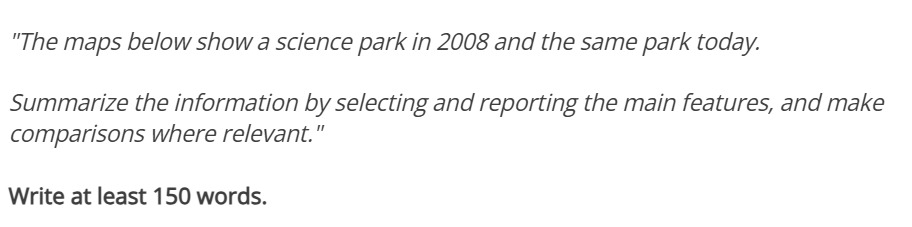
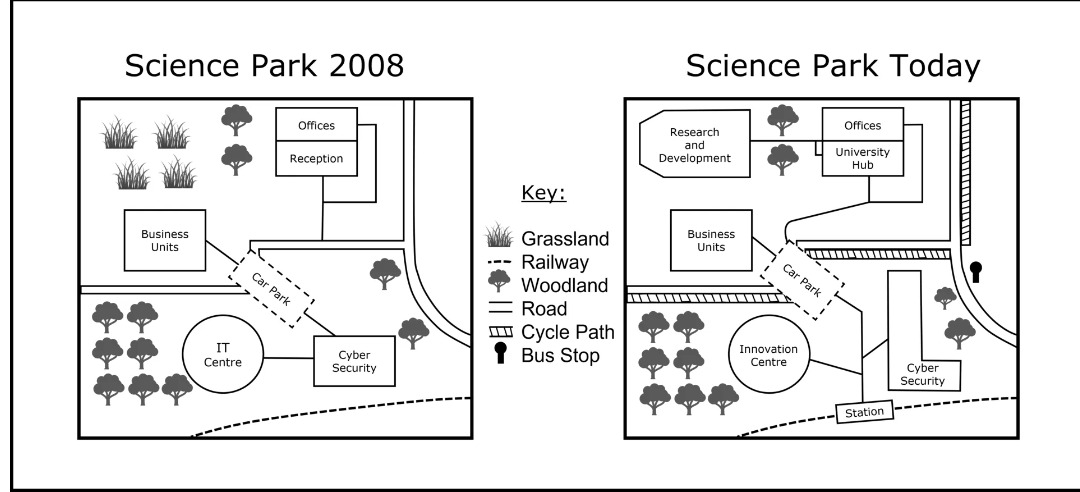
Topic: Changes to a science park (2008 vs today).
Introduction
The maps illustrate how a science park has transformed since 2008.
Overview — what changed vs what stayed
Overall, the park has undergone considerable modifications, including the addition of new facilities and conversions of the previous ones. The natural setting seems to have remained mostly intact.
Body 1 — northern / central changes + location language
Since 2008, a cycle path has been developed alongside the road running near the eastern boundary, with an extension to the west through the centre. The car park in the centre has been enlarged. The Cyber Security building near the railway in the southeast has been rebuilt in an L shape, while a new railway station has been added. No alterations have been made in the surrounding area, such as the woodland, except for the installation of a new bus stop. While the IT centre has now been repurposed as an Innovation Centre, the large woodland to its west stands as it did in 2008.
Body 2 — southern area (turning phrase)
Turning to the southern part of the park, Business Units have been maintained without modification. The grassland has been cleared to make way for Research and Development. The woodland to its east has been preserved. Finally, although the offices in the east have persisted unchanged, the reception to their south has been redeveloped as a university hub.
Map paragraph openers
- Since 2008, / A … has been developed / has been enlarged / has been rebuilt
- Turning to the southern part… / To the north of… / In the centre
- Always pair change with unchanged features in the overview
Model report — Band 8.5+ (process)
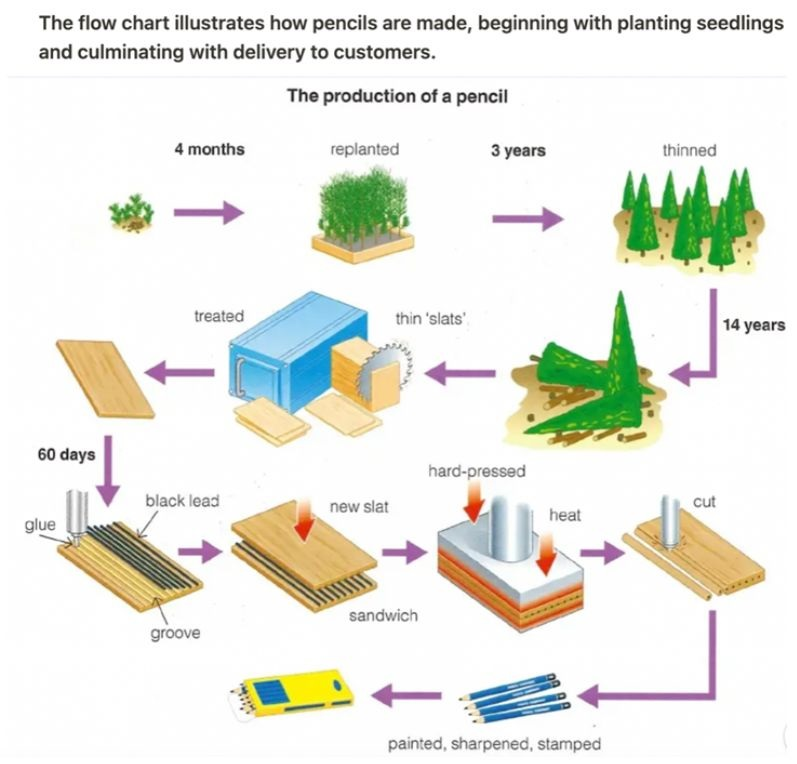
Topic: How pencils are manufactured.
Introduction
The process illustrates the manufacturing of pencils.
Overview — stages + passive hint
Overall, the process entails two major stages, which can be further categorised into several phases. Some stages entail a waiting period that may extend for months or even years.
Body 1 — early stages (natural process)
In detail, first, seedlings are cultivated in soil, and a period of four months must elapse before they are replanted. Three years after this phase, they are thinned. The trees are harvested after a 14-year growth period.
Body 2 — manufacturing stages (passive voice)
In the subsequent stage, the felled trees are cut into thin slats using a cutting machine prior to undergoing a treatment procedure. Following a time span of 60 days, grooves are cut into the wooden sheets, and they are supplemented with glue. Simultaneously, black leads are positioned between slats. Next, wood pieces are assembled into a sandwich using a hard-pressed machine which also applies heat. Another cutter is then used to slice the material into elongated cylindrical shapes. In the next stage, pencils are coated with various colours, sharpened and stamped, after which they are prepared for packaging. Ultimately, packages are delivered to customers.
Process paragraph openers
- Start: First, / In detail, first,
- Next stage: In the subsequent stage, / Next, / Following… / Ultimately,
- Passive: are cut / are harvested / are coated / are delivered — no need to name the worker
Task 2 — Balanced essays plan
Use the tabs to jump to each essay type. Copy, save, and right-click are blocked here (best-effort).
When “balanced” helps
Only the following essays can be written using a balanced approach. However, it does not mean that you have to use a balanced approach to write these essays. It is just that writing these essays using a balanced approach is always better because it allows you to cover the topic and the question more comprehensively.
Opinion / agree-disagree
- Agree/disagree essays (some people call these opinion essays).
- Typical prompts: Do you agree or disagree? To what extent do you agree (or disagree)? What is your opinion?
- Example topic: Some people think that human needs for farmland, housing and industry are more important than saving land for endangered animals. Do you agree or disagree with this point of view? Use specific reasons and examples to support your choice?
- Approach (a): Agree but under some conditions.
- Approach (b): I agree but there may be some exceptional cases.
- Intro: Paraphrase the topic sentence.
- Sample stance: In my view, while I believe that humans, especially the young, should be prioritised over protecting endangered animals, we should not ignore all species that are at risk of extinction.
- Body 1: I agree because humans are more important than animals — we cannot raise children in an environment where they are half-hungry and have no place to play, damaging their psychology.
- Body 2: But this does not mean we can give up on all endangered animals; some are extremely important. For example, which ones???
-
Conclusion: Restate your main arguments shortly (which have been explained in Body 1 and Body 2).
Note: Do not give or mention new arguments that have not been analyzed or explained in body paragraphs.
Model essay — Band 8.5+ (balanced agree / disagree)
Topic: Intelligence is the most important quality for a leader. Do you agree or disagree?
Introduction — paraphrase + balanced stance
Intellectual competence is of the utmost significance to a leader. In my view, while every leader should have intellectual capability, an individual without communication skills and moral integrity cannot retain their position in the long term.
Body 1 — why you agree (main side)
On the one hand, leaders frequently analyse complex information, weighing and anticipating both favourable and adverse consequences of decisions simultaneously. Leaders bear responsibility for organisational setbacks, suggesting they should possess advanced cognitive judgement and strategic foresight. For instance, a renowned football coach, Gurban Gurbanov, was subjected to countless criticisms in the past but is now praised for the outstanding performance of his team on the international stage. Therefore, intellectual competence is essential for leaders, given that they shoulder the principal burden of responsibility.
Body 2 — the “but” side (conditions / other qualities)
However, leadership efficacy also depends on interpersonal and ethical attributes. First, even highly intelligent leaders are prone to failure in the absence of sound communication abilities. To clarify, when leaders struggle to articulate their vision to those under their command, their followers may not fully grasp the scope of the objective or misinterpret their role in it. Therefore, a leader should be able to convey their vision to all team members or persuade stakeholders, which necessitates effective articulation of strategic vision.
Moreover, without ethical integrity, a leader is unlikely to maintain authority over time. This is attributable to the fact that ethical misconduct gradually erodes trust and organisational stability. For instance, if a team leader takes credit for subordinates’ work, employees may feel undervalued and disengaged. Over time, reduced morale and increased turnover weaken the organisation’s performance and undermine the leader’s authority.
Conclusion — restate both sides (no new ideas)
To conclude, intellectual capacity is undeniably fundamental to effective leadership, as leaders must exercise strategic judgement and informed decision-making, especially given that they assume ultimate accountability for organisational outcomes. Nevertheless, it does not constitute a complete framework without refined interpersonal communication skills and adherence to moral codes; in their absence, a leader’s legitimacy and long-term effectiveness can be significantly undermined.
Why this essay is Band 8.5 / 9.0
- Task response: The question asks whether intelligence is the most important quality. The writer does not give a simple yes/no. They use a balanced opinion: intelligence matters, but it is not enough alone. That fully answers the question.
- Clear paragraph jobs: Body 1 proves intelligence is vital (reason → explanation → example → link). Body 2 adds two separate limits — communication and ethics — without repeating Body 1.
- Cohesion: Openers are easy to copy: In my view, while… (intro), On the one hand, [reason]. (agree side), However, [limit]. / Moreover, [second limit]. (other side), To conclude, (summary).
- Lexis & grammar: Precise nouns (cognitive judgement, strategic foresight) and complex sentences — but the logic stays easy to follow. That is typical of Band 8.5+ writing.
- Conclusion rule: Nothing new appears at the end. The conclusion only summarises intelligence + communication + ethics from the body paragraphs.
How each paragraph starts (copy these patterns)
- Intro: Paraphrase the topic in one sentence → In my view, while [I agree partly], [main limit].
- Body 1 (agree): On the one hand, [reason / main side]. → To clarify / For instance → Therefore
- Body 2 (but): However, [limit / other side]. → Moreover, [second limit]. (optional if you have space)
- Conclusion: To conclude, restate side 1 + Nevertheless, restate side 2
Discussion (both views + your opinion)
- Discussion essays: discuss both sides and give your opinion.
- Prompt example: It is generally believed that some people are born with talents while others are not. However, it is sometimes claimed that any child has certain talents, for instance for sport or music, and can be taught to become a good sports person or musician.
- Task wording: Discuss both these views and give your own opinion.
-
Ways to respond:
- a) Both views are wrong.
- b) There may be cases where both are correct — it depends on the situation (both views can be correct depending on the country, age, or specific field).
-
Structure (c):
- Intro — Paraphrase the topic + your opinion.
- Body 1 — Discuss the first side and why they think this way (1 reason + explanation).
- Body 2 — Discuss the second side in the same way.
- Body 3 — My personal opinion.
- Conclusion: In conclusion, although people may vary in their opinions, I am convinced that + state your opinion. (Your opinion should shortly show why your approach is better; shortly mention your arguments explained in Body 3.)
-
My opinion on this topic:
I believe that anyone can be successful in any sport if they do not have a physical disability that prevents it; similarly, anyone can be successful in music, even if they don't have a natural voice — thanks to technology.
The only difference between them and those born talented is that they will have to work much harder to achieve success.
Model essay — Band 8.5+ (discussion: both sides + opinion)
Topic: Some people think cooking should be taught in schools, while other people think children should learn this at home. Discuss both sides and give your opinion.
Introduction — paraphrase both sides + your opinion
According to some, cooking skills should be incorporated into the school curriculum, whereas others contend that parents should assume this responsibility. In my view, a combination of both approaches would yield the most comprehensive results, as long as schools do not assign cooking tasks as homework.
Body 1 — first view (schools should teach cooking)
On the one hand, some maintain that teaching cooking in schools contributes to equal access to essential life skills. To clarify, the ability to cook independently is an essential life skill that is not cultivated in every household. Structural factors such as demanding work schedules, reliance on convenience foods, and limited culinary knowledge among parents may restrict opportunities for children to acquire this competence. Hence, in order to reduce students’ dependence on processed fast food once they relocate for university studies, basic culinary education at schools can ensure that all students acquire this basic domestic capability.
Body 2 — second view (parents should teach at home)
On the other hand, others contend that preparing meals together can foster communication and emotional bonding between parents and children. Since learning cooking skills necessitates cooperation between parents and children, it encourages regular interaction and cooperation within the household. Through shared tasks such as preparing ingredients, following recipes, and organising kitchen work, parents can pass down practical knowledge while engaging in meaningful conversations. Over time, these routine interactions can foster stronger emotional connections and reinforce family cohesion.
Body 3 — your personal opinion
From my perspective, both approaches can reasonably be adopted at the same time. First, since children do not always completely understand what is taught in class, parents may need to reinforce this learning at home. By supervising and practising cooking activities with their children, parents can help consolidate what has been learned and ensure that these skills are effectively internalised. However, given that students are often overwhelmed by existing homework demands, learning these skills should occur at a comfortable pace rather than through additional cooking-related homework.
Conclusion — restate your opinion (no new ideas)
To conclude, despite divergent views on the responsibility for culinary education, an integrated approach involving both teachers and parents would ensure that school-based culinary literacy is complemented through domestic practice, provided that additional homework obligations are avoided.
Why this essay is Band 8.5 / 9.0
- All three parts answered: Side 1 (schools), Side 2 (home), and a clear personal view in Body 3 — not hidden only in the intro.
- Structure (c) used well: Each body paragraph has one job. Body 1 and Body 2 explain why each side thinks that way (reason → To clarify → Hence).
- Balanced but not vague: The writer does not say “both are 100% correct.” They say both can work together, with one practical limit (no extra homework).
- Language: Uses your discussion openers correctly — not opinion openers like “I completely agree.”
How each paragraph starts (discussion type)
- Intro: Paraphrase side A + side B → In my view, [your opinion].
- Body 1 (view 1): On the one hand, some maintain that… → To clarify → Hence
- Body 2 (view 2): On the other hand, others contend that… → explanation → result
- Body 3 (your opinion): From my perspective, [your combined view].
- Conclusion: To conclude, + although / despite + restate your view from Body 3
Positive / negative development
- Positive/negative essays: Is this a positive or negative development / approach?
- Intro: Paraphrase + your opinion.
- (a) In my opinion, it is positive, but only if certain conditions are met.
- (b) In my opinion, this varies from person to person, country to country, age to age, man to woman, and profession to profession.
-
Language: For instance: Is Alex a good teacher?
- “Alex, as a teacher, offers advantages” — INCORRECT. (The fact that someone has good sides does not show that he or she is a good teacher.)
- “Alex is a good teacher.” — CORRECT.
- “This trend has advantages” — INCORRECT.
- “This trend is advantageous” — CORRECT.
-
Example question: Most people accept that we now live in a globalised world but not everyone agrees that this is beneficial. To what extent is globalisation a positive or negative development? (It varies from country to country.)
- Body 1: This is positive for developed countries.
- Body 2: It is a problem for developing (weakly developed) countries — exposure to exploitation.
Model essay — Band 8.5+ (positive / negative — approach a)
Topic: In some countries, more and more shops are open long hours every day of the week. Is this a positive or negative development for shoppers and the local community?
Introduction — paraphrase + clear judgment
In some places, shops with longer work hours, without weekend breaks, are becoming more and more prevalent. I am convinced that this trend is largely a positive development, provided that potential negative implications are regulated.
Body 1 — why it is positive (reason 1)
To begin, with extended work hours, consumer traffic is distributed more evenly. To clarify, since people are aware that they do not have to rush to shopping centres before they are closed, they opt to do shopping at their convenience. This not only contributes to shorter queues but also reduces traffic flow. In contrast to locations where the opening and closing hours of numerous shops overlap, a smaller influx of individuals hurries to shops, knowing that they are not compelled to complete their shopping by a certain time.
Body 1 continued — why it is positive (reason 2)
Moreover, longer business hours require additional staffing. This is attributable to the fact that a 24/7 work schedule cannot be pragmatically implemented without a sufficient number of shop assistants and cashiers. Hence, this urges shop owners to open vacancies for both daytime and evening shifts to accommodate consumers who shop at different times of the day. Hence, new employment opportunities emerge for both locals and students who are mostly interested in part-time job offers.
Body 2 — limits / when it becomes negative (use if)
However, if certain precautionary measures are not taken, these benefits are compromised. First, if many shops receive new commodities by truck during night hours, the noise from transport and working staff can be a hindrance to people’s rest. Coupled with increased traffic at night, people in the neighbourhood may be disturbed. If not regulated by authoritative figures, the ubiquity of shops with long work hours can interrupt people’s otherwise improved shopping experience. Furthermore, constant availability may promote impulse buying and excessive consumption. This can also negate the benefit of increased job options for students, who sometimes lack the maturity to resist consumerism’s appeal. Only by setting a limit on the shopping age, such as over 25, can this potential negative outcome be averted.
Conclusion — restate judgment + conditions
To conclude, having many shops that operate beyond regular work hours may be considered a positive trend overall, as it reduces congestion in cities and increases the number of available jobs. However, unless several countermeasures, such as regulating product transportation and restricting the shopping age, are implemented, consumerism and irregular traffic flow seriously undermine these benefits.
Why this essay is Band 8.5 / 9.0
- Correct language: The writer says the trend is positive — not “has advantages” (your rule from above).
- Approach (a): Positive but only if regulations exist. Body 2 uses However, if… sentences — exactly what you teach for conditional balanced answers.
- Two clear positives in Body 1 (less rush / more jobs), then risks + solutions in Body 2 — no new ideas in the conclusion.
- Accessible topic: Every student understands shops, traffic, and jobs — good model to copy.
How each paragraph starts (+ / − type)
- Intro: Paraphrase the trend → I am convinced that this trend is largely positive, provided that…
- Body 1 (+): To begin, [why it is positive]. / Moreover, [second positive point].
- Body 2 (− / conditions): However, if [condition is missing], [negative result]. → Only by… + solution
- Conclusion: To conclude, positive overall + However, unless…
Advantages outweigh disadvantages
- Important: Only when the question uses the word outweigh. If you do not see “outweigh”, you cannot use this “which side is stronger” balanced answer for a simple “discuss the advantages and disadvantages” task.
-
Here are 3 approaches you can take to write this essay type:
- (a) It may or may not outweigh, provided certain conditions are met. Body 1 — Cases where it outweighs. Body 2 — What measures have been taken against the factors that put this outweighing at risk (must use if sentences).
- (b) From person to person, country to country: Body 1 — In which country or for which types of people the positives outweigh and a comparison with possible negatives. Body 2 — In which country the negatives create a more serious problem and make possible positives meaningless.
- (c) A mixture of (a) and (b).
-
Example: Some companies spend a lot of money on scientific research and use animals for testing. Do the advantages of using animals in research outweigh its disadvantages?
- Intro: Paraphrase the topic + your opinion (e.g., it depends on the magnitude of the research).
- Body 1: Research involving medical research is good.
- Body 2: But for luxury and beauty products, the negative aspects are too serious.
Model essay — Band 8.5+ (outweigh — approach b: depends on situation)
Topic: In many countries small shops and town centres are going out of business, because people tend to drive to large out-of-town stores. This results in an increase in car use and it also means that people without cars have limited access to out-of-town stores. Do the advantages of such development outweigh its disadvantages?
Introduction — paraphrase + “it depends”
In the majority of countries, due to people opting to shop in major retail establishments located outside town centres, small-scale shops eventually cease to operate. This culminates in a rise in private vehicle usage and limited availability for those without a car. I am convinced that whether the merits of this trend outweigh its demerits largely depends on certain circumstances.
Body 1 — when advantages outweigh (case where positives win)
On the one hand, this change can produce favourable outcomes that are more significant compared to some potential consequences in certain cases. For instance, many such chain stores offer their own bus services that run through different regions of a town and carry passengers to stores outside the town at no extra charge as long as they shop. In this scenario, people without a car are not exempt from taking advantage of cheaper products or discounts in these stores. Moreover, it also allows individuals to purchase a monthly supply in a single trip. This contributes to saving time and money, which is perhaps twice as high as for people who regularly shop after every other workday. In these instances, the possible negative effects of this trend are too negligible to notice.
Body 2 — when disadvantages outweigh (opposite case)
On the other hand, this can prove to be catastrophic if company-operated buses are not available. The most likely issue would be traffic jams, for many people commute to these venues, especially during rush hours, which inevitably leads to congestion. In cities where traffic is not properly regulated or the road infrastructure is poorly designed, people waste their time and money rather than achieve time and cost efficiency. Another adverse effect, as a result of an upsurge in automobile usage, is elevated levels of harmful gases released into the air, thereby increasing air pollution.
Conclusion — answer the “outweigh” question clearly
To conclude, in my view, the potential benefits of people shopping mostly in suburban shopping complexes may outweigh the drawbacks, depending on certain conditions: when such facilities offer their dedicated bus services, people can enjoy traffic-free trips and reasonably priced commodities. Otherwise, people are likely to have to endure prolonged driving and degradation in air quality in cities.
Why this essay is Band 8.5 / 9.0
- Answers “outweigh” directly: Not just a list of pros and cons — the writer says positives can outweigh negatives in some cases, not in others.
- Approach (b): Body 1 = situation where advantages win (free bus + bulk shopping). Body 2 = situation where disadvantages win (no bus → traffic + pollution).
- Comparison language: Uses too negligible to notice vs catastrophic — shows which side is stronger in each scenario.
- Conclusion mirrors Body 1 + Body 2: “When… Otherwise…” — no new arguments.
How each paragraph starts (outweigh type)
- Intro: Paraphrase problem → I am convinced that whether the merits outweigh the demerits depends on…
- Body 1 (when + outweighs −): On the one hand, [case where positives are stronger]. → For instance / Moreover
- Body 2 (when − outweighs +): On the other hand, [if condition missing], [negative result].
- Conclusion: To conclude, in my view, + when advantages win + Otherwise + when they do not
Direct questions (two-part prompts)
- Typical wording: Why is this? Is it positive or negative? What are the reasons? What can be done? Should X or Y? — often two questions in one prompt.
- No single fixed structure. You must read both questions and answer both fully.
- Most common layout: Body 1 answers question 1 (causes / reasons / why). Body 2 answers question 2 (positive/negative, solution, or choice).
- Balanced approach often works — especially when Q2 is “Is this positive or negative?” Use the same language as +/− essays: say the trend is positive / is negative, not “has advantages.”
- Intro: Paraphrase the situation + brief preview of both answers (causes + your judgment, or reasons + solutions).
- Conclusion: One sentence per question — do not introduce new ideas.
Model essay — Band 8.5+ (Why + positive/negative?)
Topic: Some children spend hours every day on their smartphones. Why is this the case? Is it a positive or negative trend?
Introduction — paraphrase + preview both answers
Some children engage in extensive daily smartphone use. This is attributable to parents’ hectic work schedules and the lack of alternative forms of entertainment. I am convinced that this is largely a favourable development, provided that children use mobile phones under parental supervision.
Body 1 — answers “Why?” (question 1)
The key factor behind children’s prolonged smartphone use is parental fatigue following long work hours. To clarify, in order to cope with modern economic pressures, ranging from healthcare to educational expenses, parents are forced into demanding jobs or multiple professional engagements. Hence, work-related exhaustion leaves them with limited capacity for meaningful parent-child interactions, so they use mobile phones to keep their children occupied. Furthermore, the limited availability of safe and affordable outdoor play areas leads to smartphones substituting for physical recreational outlets. Nowadays, the scarcity of child-exclusive recreational facilities means that children often rely on public parks. However, these areas are also shared with adults some of whom may pose a danger to children. Compounding this issue, child-only entertainment venues are prohibitively expensive for many families.
Body 2 — answers “Positive or negative?” (question 2 — balanced)
Nevertheless, the consequences of this trend are not inherently negative, as its impact varies depending on contextual and individual circumstances. For instance, despite permitting children to dedicate hours to smartphone use, most parents do so while ensuring that their children are not exposed to harmful content. To illustrate, through parental control software, content inappropriate for children is restricted. Instead, children are granted access only to age-appropriate digital sources, such as educational videos. Meanwhile, such software also enables the imposition of time limits on smartphone use. Under these conditions, parents avert potential risks of phone addiction and the adverse effects resulting from unsuitable online material, such as the normalisation of maladaptive behaviours. This, in turn, renders smartphone use a favourable development.
Conclusion — one line per question
In conclusion, while parents may feel compelled to permit smartphone use due to structural and time constraints, its overall impact remains predominantly positive, on the condition that strict measures are taken to mitigate risks such as addiction and negative behavioural development.
Why this essay is Band 8.5 / 9.0
- Both questions answered: Body 1 = why (busy parents + no safe play areas). Body 2 = positive or negative (positive if supervised).
- Balanced +/− language: Says the trend is a favourable development under conditions — correct grammar for this essay family.
- Flexible structure: Not forced into “discussion” or “outweigh” format — layout follows the two questions directly.
- Easy to follow: Parents, parks, parental controls — concrete ideas students can reuse in other direct tasks.
How each paragraph starts (direct — Why + +/−)
- Intro: Paraphrase → This is attributable to… I am convinced that this is largely positive/negative, provided that…
- Body 1 (Why?): The key factor behind [topic] is… → To clarify / Hence → Furthermore, [second reason].
- Body 2 (+/−?): Nevertheless, [your judgment on positive/negative]. → For instance / To illustrate → Under these conditions…
- Conclusion: In conclusion, restate cause + restate judgment with condition
Other direct pairs: What are the reasons? Is this positive or negative? → same layout. What are the causes? What can be done? → Body 1 = causes, Body 2 = solutions (like problem–solution, but triggered by two direct questions).
Task 2 — No opinion & other essay types
Use the tabs to switch between advantage/disadvantage and problem–solution notes.
No opinion — advantages & disadvantages
- Advantages / disadvantages essays: Discuss the advantages and disadvantages. What are the advantages and disadvantages? — only when the word “OUTWEIGH” is not present.
- Personal opinion is not expressed. Statements like “The positive sides are more / more important” or the opposite are INCORRECT (OLMAZ).
- Body 1: Two positive points.
- Body 2: Two negative points.
-
Structure (overview):
- Intro: Paraphrase the topic + “Although this trend can produce some merits, it can also lead to some issues.” (Easy version.)
- Body 1: Positive sides.
- Body 2: Negative sides.
- Conclusion.
- Example: Globalisation affects culture and economy. What are its advantages and disadvantages?
Structure in detail — how to start each paragraph
Use this when the question asks for advantages and disadvantages without “outweigh”. Replace X with the topic (noun phrase or gerund).
1. Introduction
General statement (pick one opening pattern):
- In modern times, the issue of … (noun phrase) … has become highly controversial.
- In the modern era, … … … have become an essential part of everyday life.
- The last few decades have seen enormous changes in the way of people’s lives that are affected by …
- These days, more and more … … … are … … …
- An increasing concern for many people around the world is …
- One of the most topical issues in modern society is …
Main statement (no fixed structure — choose one):
- A) In this essay, the benefits and downsides of this argument/phenomenon/issue/trend will be discussed.
- B) This essay will examine the positive aspects and drawbacks of this argument/phenomenon/issue/trend.
2. Body 1 — advantages
- Point 1 — open with:
- A) Perhaps the main advantage of X is + noun phrase / that + subject + verb …
- B) One evident benefit to X (noun phrase / gerund) is that …
- Explain: In other words / That is to say / To be more specific …
- Example: For example, … / A good illustration of this is that …
- Point 2 — link: Secondly; Furthermore; In addition; etc.
- Explain again: In other words / That is to say / To be more specific … (other linking phrases will be taught)
3. Body 2 — disadvantages
Open the paragraph (pick one):
- Despite these advantages, there are also various disadvantages to X.
- Despite the advantages above, many people feel that … has negative aspects … for a number of reasons.
Then use the same pattern as Body 1 — disadvantage opener → explain → example → second point → explain.
4. Conclusion
- In conclusion, while there are plus points to X, there are also disadvantages such as … and … (name the disadvantages exactly — do not introduce new ideas).
Model essay — Band 8.5+ (advantages & disadvantages, no opinion)
Topic: Globalisation affects culture and economy. What are its advantages and disadvantages?
Introduction — paraphrase + preview both sides (no “which is stronger”)
The process of globalisation transforms both cultural landscapes and economic frameworks. While this trend entails several advantages, such as increased international trade and cultural tolerance, it also generates notable employment and cultural concerns.
Body 1 — advantages (two points)
On the one hand, global integration of markets and societies enhances international economic relations. To clarify, globalisation strengthens international economic relations by facilitating cross-border trade, investment, and collaboration. Subsequently, tariffs are reduced, regulatory frameworks become aligned, and businesses can operate more efficiently across national boundaries. Moreover, globalisation also promotes intercultural understanding. Increased mobility enables individuals to encounter diverse customs and belief systems, thereby broadening their understanding of differing viewpoints. This development consolidates transnational social cohesion, thereby attenuating both micro-level interpersonal tensions and macro-level geopolitical conflicts.
Body 2 — disadvantages (open with contrast linker)
On the other hand, globalisation can produce counterproductive outcomes. First, this phenomenon can destabilise the balance in the allocation of economic resources. To explain, the liberalisation of trade allows corporations to relocate production to countries where operating expenses are minimal. While this maximises corporate profitability, it can undermine domestic industries, particularly in sectors unable to compete with cheaper imports. As a result, certain segments of the workforce experience declining wages or unemployment, leading to financial instability. Furthermore, globalisation puts some cultures at risk of being overshadowed by other cultures. This is more pronounced among smaller cultures, in which norms are being supplanted by those of more dominant cultures. Such displacement may result in the irreversible loss of intangible heritage, weakening community cohesion and historical continuity.
Conclusion — both sides named, no personal verdict
To conclude, although globalisation fosters global trade and cultural openness, it can also erode cultural identity and amplify economic stratification.
Why this essay is Band 8.5 / 9.0
- No opinion: The writer never says positives are “more important” — only lists both sides. That is exactly what this essay type requires.
- Two + two: Body 1 = trade + cultural openness. Body 2 = job losses + cultural loss. Balanced coverage.
- Uses your intro pattern: While this trend can produce some merits, it can also lead to some issues — same idea, more advanced wording.
- Conclusion rule: Names advantages and disadvantages from the body — nothing new.
How each paragraph starts (adv. & disadv., no opinion)
- Intro: General statement → While… advantages…, it also… concerns/issues.
- Body 1 (+): On the one hand, [first advantage]. → To clarify → Moreover, [second advantage].
- Body 2 (−): On the other hand, [first disadvantage]. → First… Furthermore… (second disadvantage)
- Conclusion: To conclude, although…, it can also… (both sides, no winner)
Problem & solution
In a Problem–Solution essay, there is normally no opinion.
If there are words that directly ask for your opinion, such as “YOU think” or “what can you suggest,” you should add “I consider that…” The rest of the structure remains the same. Sometimes “In my view…” is added to the conclusion—but normally, these essays do not include an opinion.
- Intro: Paraphrase the topic + “However, some steps can be taken to solve these issues.”
- Body 1: You talk about the root of the problem or the problem itself — 2 arguments. In some questions, it asks for “effects / what problems does this cause?”: in that case, we don’t say why it happens; we talk about the result.
- Body 2: Solutions.
- Conclusion.
- Example: The number of homeless people is rising in many countries. What are the reasons and how can this problem be solved?
-
Note: Know the difference between “cause and effect” as some questions do ask you about the effects and solutions.
- Reasons / causes: “What are the causes?” “Why is this?” “What are the reasons?” — these require you to discuss the reasons for a problem.
- However — effects: “What problems does this cause?” “What are the effects of this?” “What problems are associated with this?” — these ask you to discuss the effects of a situation.
Structure in detail — how to start each paragraph
Replace X with the topic. In Body 1, use the causes or effects set depending on the question wording.
1. Introduction
General statement (pick one opening pattern):
- In modern times, the issue of … has become highly controversial.
- In the modern era, … … … have become an essential part of everyday life.
- The last few decades have seen enormous changes in the way of people’s lives that are affected by …
- These days, more and more … … … are … … …
- An increasing concern for many people around the world is …
- One of the most topical issues in modern society is …
Main statement (match the question — pick one type):
- Causes: The main causes of X are … + noun phrase / This is mainly because of …
- Effects: There are two main results of X / There are a variety (or number) of issues which result from X.
- Solutions (preview): There are a number of solutions which should be implemented to deal with X.
2. Body 1 — causes or effects
Topic sentence — causes (pick one, then First, …):
- A) There are two main reasons why … (topic) …
- B) There are two main causes of … (topic) …
- C) The primary reason for … (topic) is … (first reason)
Topic sentence — effects (when the question asks about problems/results, not reasons):
- There are two main issues which are caused by … (topic). First, …
Support & second point:
- Support sentence: In other words / That is to say / As a result / In consequence (choose carefully — “As a result” and “In consequence” fit effects more than causes)
- Second point: Secondly; Furthermore; In addition
- Another point: Another cause / result of X is …
- Support again: … (explain the second point)
3. Body 2 — solutions
Open the paragraph (pick one):
- However, there are a variety of possible solutions available to address this problem.
- Despite these challenges, there are a number (or variety) of ways to resolve this issue.
- There are two effective solutions to the problem of X.
Solution points:
- The main way to combat this issue is by + gerund …
- A second potential solution is …
- One way to tackle this is …
- Support: … (explain how the solution works)
- Second solution: Secondly; Furthermore; In addition …
4. Conclusion
- In conclusion, despite this problem having become common in many places, were … and … to be implemented, this issue would hopefully be solved soon. (Name the solutions from Body 2 — do not introduce new ideas.)
Model essay — Band 8.5+ (causes + solutions)
Topic: Many countries increase the amount of household garbage going to landfill every year. What are the causes and what can be done to reduce it?
Introduction — state the problem + preview causes & solutions
Domestic waste output by an average household is rising at an alarming rate. This is attributable to the recently prevailing consumer culture and lack of recycling. However, through improved recycling systems and awareness campaigns, this pressing issue can be addressed.
Body 1 — causes (two reasons)
The key factor behind escalating residential waste generation is that modern lifestyles encourage people to buy more goods, often with short life cycles. To clarify, mass production and aggressive marketing encourage frequent replacement of products such as electronics, clothing, and household items. Most of these items are wrapped in plastic and have short life cycles, thereby increasing waste. Furthermore, in some countries, recycling infrastructure is limited. For instance, inadequate public awareness of waste separation results in many individuals disposing of recyclable and non-recyclable waste together, without recognising the environmental consequences. Compounding this issue is the lack of clearly designated recycling bins, which further exacerbates improper waste segregation.
Body 2 — solutions (open with contrast linker)
However, to eradicate the root causes of excessive waste, authorities should provide accessible recycling bins and implement efficient waste sorting facilities. When supported by educational campaigns promoting responsible disposal behaviour, accessible recycling facilities can substantially mitigate waste generation. Moreover, governments should impose regulations on packaging. To illustrate, governments can limit single-use plastic and require recyclable packaging. Given that direct restrictions on consumer purchasing behaviour would undermine freedom of choice, producer responsibility legislation represents a more pragmatic policy response. These measures maintain a balanced distribution of accountability between consumers and producers.
Conclusion — causes + solutions named (no new ideas)
To conclude, escalating consumer spending, widespread plastic overconsumption, and inadequate recycling infrastructure contribute to rising waste levels. Nonetheless, without undermining consumer autonomy, this pressing issue can be mitigated through regulatory controls on plastic production, improved waste management infrastructure, and public awareness initiatives regarding irresponsible waste disposal.
Why this essay is Band 8.5 / 9.0
- Both parts answered: Causes in Body 1, solutions in Body 2 — the question asks for both, and the essay delivers both clearly.
- No unnecessary opinion: The writer explains why waste rises and what to do — no “I think pollution is terrible” padding.
- Two causes + two solutions: Matches your structure notes (two arguments per body paragraph).
- Realistic solutions: Recycling bins + packaging laws — specific and believable, not vague “people should care more.”
How each paragraph starts (problem & solution type)
- Intro: State the problem → This is attributable to… However, through… this issue can be addressed.
- Body 1 (causes): The key factor behind [topic] is… → To clarify / For instance → Furthermore, [second cause].
- Body 2 (solutions): However, to eradicate…, authorities should… → Moreover / To illustrate
- Conclusion: To conclude, restate causes + Nonetheless, restate solutions from Body 2
Listening
Listening content loads from listening-tests.json. If an audioSrc is provided, an audio player will appear here.
Flashcards
Build your vocabulary and ace the exam.
Total words
—
Across both decks
Self-checks
—
Cards you’ve checked
New (7 days)
—
Added to Reading deck
Need practice
—
Study streak
—
Days you added cards
Words you save during Reading tests (Look up / + Card). Stored on this device.
0 wordsPractice session
How practice works
Tap Practice deck to quiz yourself. Pick a Translation language for glosses — save a word again from Reading with another language selected to add more translations.
·
Choose words for practice
Select up to — words.
0 selected
1 / 1
No words saved yet
During a Reading test, select a word in the passage, then tap Look up or + Card to save it here.
Prefer a ready-made list? Try the Ramazz list or My words tabs above.
Curated academic word list (Ramazz). Filter by CEFR level, then start a quiz.
Practice session
Your personal word list. Add words below or import from my-words.json.
Practice session
Recommended
Vocabulary Studio (Ramazz List)
Study the Ramazz academic word list with definitions, example sentences, and quizzes to strengthen your vocabulary.
Total words
1462
Your progress
0%
Your deck
From Reading
Words you save from real passages stay in this deck. Export them anytime, or add more while you practice Reading tests.
Saved words
0
Deck usage
0%
144 topics · written sample answers for every one
Timer: 05:00
Speaking
Speaking practice with suggested timing (no recording required). Use the prompts and the timer to rehearse.
Topics & prompts: use the menus in the card below. To practise your own wording, enable My own question (Parts 1 & 3) or My own cue card (Part 2) inside the card.
Recording: 00:00
Your Speaking Progress
Total Practice
0
Sessions
Completed
0
Sessions
Avg. Band Score
–
Last 5 sessions
Total Time
0m
Spent practicing
Saved Part 1 Answers
Saved Part 2 Answers
Saved Part 3 Answers
Speaking attempt