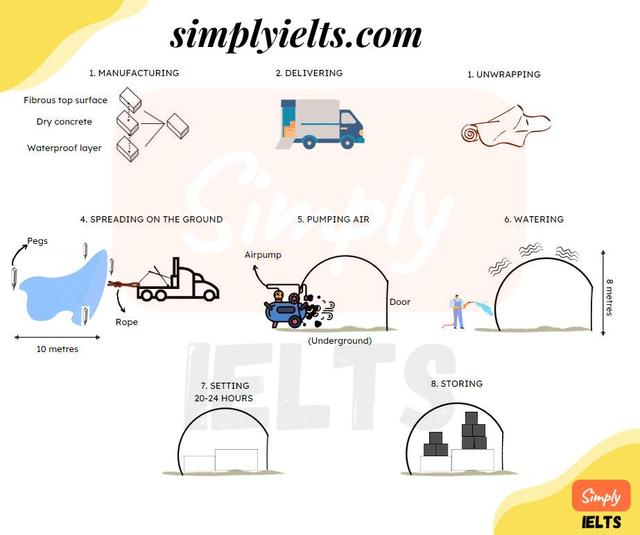
The diagram shows a process of making a storage area from a material called concrete canvas
A full IELTS Academic Writing Task 1 answer to this process diagram at Band 6.0, 7.0, 8.5, with the four-part structure, the comparison language it needs, and why each version scores what it does.
The question
You should spend about 20 minutes on this task.
The diagram shows a process of making a storage area from a material called concrete canvas.
Summarise the information by selecting and reporting the main features, and make comparisons where relevant.
Write at least 150 words.
The process of making a storage area from concrete canvas.
What to select from this process diagram
Eight stages in a straight line with no branches, so the marks come from sequencing language and from the passive rather than from selection. Two details give the answer precision: the material is made of three named layers, and two figures are given — ten metres of canvas and a setting time of 20 to 24 hours. Including those and the dimension of the finished shelter shows you read the diagram rather than the labels alone.
Structure
Introduction — Paraphrase: what the diagram shows and roughly how many stages it involves.
Overview — No detail: a linear process from manufacturing a layered fabric to a finished storage building, with the shelter formed on site by inflation and water rather than by construction.
Body 1 — Stages one to four — manufacture, delivery, unwrapping and laying out.
Body 2 — Stages five to eight — inflation, watering, setting and use.
Model answers
Band 6.0 model answer
178 words
The diagram shows how people make a storage area from a material called concrete canvas. There are eight stages in this process.
First, the material is manufactured. It has three layers: a fibrous top surface, dry concrete in the middle and a waterproof layer at the bottom. After that, the material is delivered to the place by a lorry.
Then the workers unwrap the material, because it comes as a big roll. In the next stage they spread it on the ground. The canvas is about ten metres long and they fix it with pegs and a rope, and they use a vehicle to pull it.
After that, air is pumped inside with an air pump, so the canvas rises and becomes like a tent with a door. The building is about eight metres high.
Then a worker puts water on the canvas with a hose. The structure must stay for 20 to 24 hours to become hard.
Finally, when it is dry, people can put boxes and other things inside, so the building is used for storing.
Why this is Band 6.0
All eight stages are covered in the correct order, which secures Task Achievement at this level.
Sequencing relies on a small set of connectors — first, then, after that — repeated throughout.
The passive is used occasionally but much of the description is active with an unnamed subject.
Vocabulary is adequate but repetitive, and the given figures are reported without comment.
Band 7.0 model answer
215 words
The diagram illustrates the eight stages involved in constructing a storage building from a material known as concrete canvas.
Overall, the process is entirely linear, beginning with the manufacture of a layered fabric and ending with a rigid shelter ready for use. What is distinctive is that the structure is not built in the conventional sense: it is laid flat, raised by air and then hardened with water on site.
The material is first manufactured in three layers — a fibrous surface on top, dry concrete in the middle and a waterproof membrane beneath. It is then transported to the site by lorry, where it is unwrapped from the roll in which it is supplied. Next it is spread across the ground, covering a length of approximately ten metres, and anchored in place with pegs and rope while a vehicle is used to draw it out flat.
Once the canvas is in position, air is pumped underneath it so that it rises into a domed shelter roughly eight metres high, with a door at one end. Water is then sprayed over the surface, which activates the concrete layer, and the structure is left to set for between 20 and 24 hours. When it has hardened, the finished building is ready to be used for storage.
Why this is Band 7.0
The overview is separate, arrives early and characterises the process as one in which a fabric becomes a building on site.
The passive is used consistently and sequencing vocabulary is varied: subsequently, at this point, once.
The given measurements and the setting time are integrated rather than listed.
Less common lexis is used accurately: layered, anchored, inflated, set.
Band 8.5 model answer
250 words
The diagram illustrates the process by which a storage building is produced from a material called concrete canvas, in eight stages.
Overall, the sequence divides into a preparation phase, in which the material is made, transported and laid out flat, and a forming phase, in which it is turned into a rigid structure on site. The distinguishing feature of the process is that no conventional construction takes place at all: the shelter takes its shape from air and acquires its strength from water.
Manufacture comes first, the canvas being produced in three bonded layers — a fibrous surface uppermost, a layer of dry concrete beneath it, and a waterproof membrane at the base. The finished rolls are then delivered to the site by lorry and unwrapped. In the fourth stage the canvas is drawn out across the ground by a vehicle to a length of some ten metres and anchored along its edges with pegs and rope, so that it is held flat and cannot shift.
The forming phase begins with inflation. Air is pumped beneath the sheet from an underground pump, raising it into a domed shelter approximately eight metres in height and fitted with a door at one end. Water is subsequently sprayed across the exterior, which activates the dry concrete layer within, and the structure is left undisturbed for between 20 and 24 hours while it cures. Once the concrete has fully hardened, the shelter is rigid and self-supporting, and goods can be moved inside for storage.
Why this is Band 8.5
The overview describes the character of the process — a flat fabric becoming a rigid building through inflation and hydration — rather than counting stages.
Groups the eight steps into a preparation phase and a forming phase, giving the description a structure the diagram itself does not supply.
Uses every figure given and identifies what the water is actually doing, which reads the diagram rather than transcribing its labels.
Lexis is precise and economical: membrane, anchored, inflated, cure, rigid, on site.
Complex structures are used flexibly, including participle clauses, an appositive and a fronted adverbial, with no strain.
Model answers written and reviewed by The English All-in-One IELTS team. They are teaching models showing what each band looks like, not real candidate scripts.
This is a process diagram question. The answers above show you what each band looks like when it is finished. What they cannot show you is how to get there from a blank page in forty minutes.
That is what our Writing Study Library is for: the structure we teach for this exact question type, the paragraph pattern that goes with it, and the sentence openers for each stage — so the essay is planned before you start writing rather than assembled as you go.
Naming the number is a neat way to paraphrase, and it signals immediately that you have taken in the whole diagram. Just make sure the count is right — miscounting a diagram you are describing is an avoidable accuracy error.
Do I need to include the measurements?
Yes. The ten metres, the eight metres and the 20 to 24 hours are the only quantitative information in the diagram, so leaving them out loses detail the examiner is looking for. Integrate them into sentences rather than listing them.
How do I avoid using 'then' in every sentence?
Vary the sequencing: <em>once the canvas is in position</em>, <em>subsequently</em>, <em>at this point</em>, <em>the finished rolls are then…</em>. Participle clauses also help — "the canvas being produced in three layers" carries sequence without a connector at all.
Is it acceptable to explain what a stage achieves?
Where the diagram shows it, yes. Saying that the water activates the concrete describes the arrow between two labelled stages. What you should avoid is technical explanation the diagram does not contain, such as how the chemistry works.