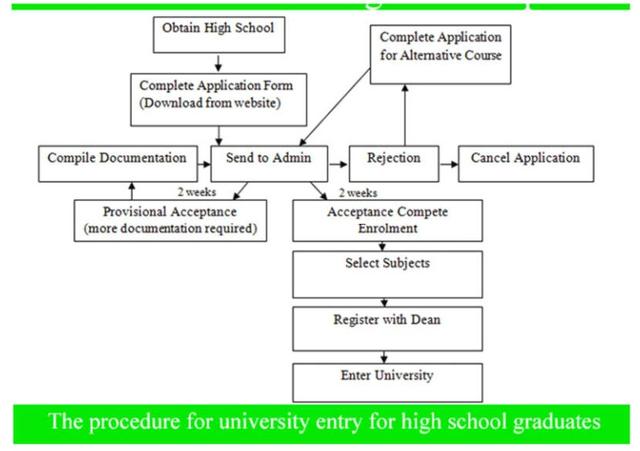
The diagram shows the procedure for university entry for high school graduates. Write a report for a university or college lecturer describing the information
A full IELTS Academic Writing Task 1 answer to this process diagram at Band 6.0, 7.0, 8.5, with the four-part structure, the comparison language it needs, and why each version scores what it does.
The question
You should spend about 20 minutes on this task.
The diagram shows the procedure for university entry for high school graduates. Write a report for a university or college lecturer describing the information.
Summarise the information by selecting and reporting the main features, and make comparisons where relevant.
Write at least 150 words.
The procedure for university entry for high school graduates.
What to select from this process diagram
A process diagram has no figures, so everything depends on sequencing language and on describing the shape correctly. This one is not a simple chain: it is linear at the start, branches into three outcomes after the admissions stage, and two of those branches loop back rather than ending. Saying so in the overview — how many stages, where it divides, and that it can repeat — is what distinguishes a Band 8 answer from a list of boxes.
Structure
Introduction — Paraphrase: what process is shown and who goes through it.
Overview — No detail: the procedure runs from leaving school to entering university, is straightforward at each end, and turns on a single decision point that produces three possible outcomes, two of which send the applicant back.
Body 1 — The application stage — obtaining the qualification through to submission and the two-week wait.
Body 2 — The three outcomes and what follows each, ending with the successful route through to enrolment.
Model answers
Band 6.0 model answer
166 words
The diagram shows the process that a student from high school must follow to enter university.
First, the student must obtain a high school qualification. After that, he completes an application form, which he can download from a website. At the same time he must compile his documentation.
Then the student sends the application to the administration. He must wait two weeks for an answer.
After two weeks there are three possible results. The first is provisional acceptance, which means the university needs more documents. In this case the student must compile the documentation again and send the application one more time.
The second result is rejection. In this situation the student can complete an application for a different course, or he can cancel his application completely.
The third result is acceptance. Then the student completes the enrolment, selects his subjects, registers with the dean and finally enters the university.
In conclusion, the process has several stages and the student sometimes must repeat some of them.
Why this is Band 6.0
Every stage is covered in the correct order, which secures Task Achievement at this level.
The three branches are described but the loops back are not clearly explained, so the shape of the process is only partly conveyed.
Sequencing relies on a small set of connectors — first, then, after that — repeated throughout.
The passive is used occasionally, and sentence structures are mainly simple and compound.
Band 7.0 model answer
216 words
The flow chart illustrates the steps a high school graduate must follow in order to gain entry to university.
Overall, the procedure consists of an application phase and an enrolment phase, separated by a single decision point at which the application is assessed. What makes the process complex is that two of the three possible outcomes at that point return the applicant to an earlier stage rather than ending the process.
The sequence begins once the candidate has obtained a high school qualification. An application form is then downloaded from the institution's website and completed, and the necessary supporting documentation is compiled. Both are subsequently submitted to the admissions office, after which the applicant waits approximately two weeks for a decision.
Three outcomes are possible at this stage. If the application is only provisionally accepted, further documentation is required, and the candidate must return to the compilation stage and resubmit. If it is rejected, there are two options: applying for an alternative course, which sends the application back to admissions once more, or cancelling the application altogether, which is the only point at which the process ends unsuccessfully. Where the application is accepted outright, enrolment is completed after a further two weeks, subjects are selected, the student registers with the dean, and entry to university follows.
Why this is Band 7.0
The overview is separate, arrives early and identifies the branching structure as the defining feature.
The loops are described explicitly, so the reader understands that the process can repeat.
Sequencing vocabulary is varied — subsequently, at this point, thereafter — and the passive is used consistently.
Less common lexis is used accurately: submit, provisional, enrolment, outcome.
Band 8.5 model answer
259 words
The flow chart illustrates the procedure by which high school graduates gain admission to university.
Overall, the process is linear at both ends and branches only once, at the point where the submitted application is assessed. That single decision produces three outcomes, and it is worth noting that only one of them terminates the process: the other two return the applicant to an earlier stage, so the application phase may be repeated several times before a final result is reached.
The procedure opens with the candidate obtaining a high school qualification, without which no further step is possible. An application form is then downloaded from the relevant website and completed, while the required supporting documentation is assembled in parallel. Once both elements are ready, they are submitted to the administration, and a period of approximately two weeks elapses before the outcome is determined.
Should the application be granted provisional acceptance, additional documentation is requested, and the candidate returns to the compilation stage before resubmitting — the first of the diagram's two feedback loops. Rejection opens two further possibilities: the applicant may complete an application for an alternative course, which recirculates the file to the administration for a fresh assessment, or may cancel the application entirely, which is the only exit from the process without admission.
Where the application is accepted, the remaining steps follow in a fixed order and without further branching. After a second interval of around two weeks, enrolment is completed, subjects are selected, the student registers with the dean, and admission to the university is finalised.
Why this is Band 8.5
The overview describes the architecture of the process — linear ends, a single branching decision, and two feedback loops — which is the most accurate possible summary of a diagram with no data.
Distinguishes the one terminating branch from the two that recirculate, which is the feature most answers miss entirely.
Uses conditional and passive constructions throughout, appropriate to a procedure applying to any applicant rather than a narrative about one person.
Lexis is precise and economical: decision point, recirculate, terminate, provisional, iteration.
Complex structures are handled flexibly, including inversion, a participle clause and a conditional without if, with no strain.
Model answers written and reviewed by The English All-in-One IELTS team. They are teaching models showing what each band looks like, not real candidate scripts.
This is a process diagram question. The answers above show you what each band looks like when it is finished. What they cannot show you is how to get there from a blank page in forty minutes.
That is what our Writing Study Library is for: the structure we teach for this exact question type, the paragraph pattern that goes with it, and the sentence openers for each stage — so the essay is planned before you start writing rather than assembled as you go.
What goes in the overview when there are no numbers?
Describe the shape of the process: how many stages, where it begins and ends, whether it is linear or branching, and whether anything repeats. For this diagram, saying that it branches once into three outcomes of which two loop back tells the reader almost everything before a single stage is named.
Should I write about "the student" or use the passive?
The passive is generally safer and more natural for a procedure — <em>the form is completed</em>, <em>the application is submitted</em> — because the process applies to anyone. Mixing in some active sentences is fine; what reads badly is a narrative about one imaginary person doing each thing.
How do I describe a branch or a loop?
Use conditionals and directional verbs: <em>if the application is rejected…</em>, <em>should it be provisionally accepted…</em>, <em>the candidate returns to the compilation stage</em>. Simply listing the boxes in the order they appear will misrepresent a diagram that does not run in a straight line.
Do I need a conclusion for a process diagram?
No — the overview does that job. If you have described the shape near the beginning, end when the final stage is reached. A closing paragraph restating that the process has several steps adds nothing the examiner can credit.