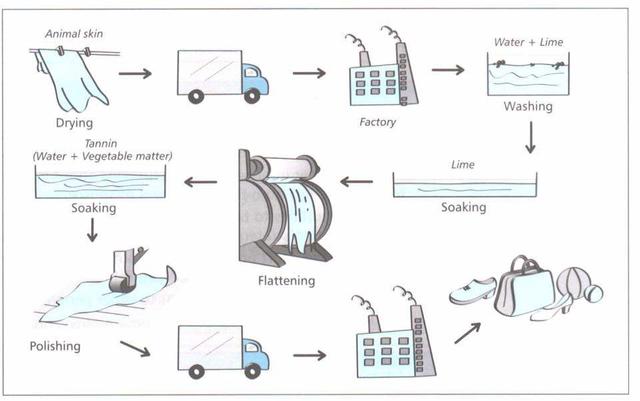
The diagram details the process of making leather products
A full IELTS Academic Writing Task 1 answer to this process diagram at Band 6.0, 7.0, 8.5, with the four-part structure, the comparison language it needs, and why each version scores what it does.
The question
You should spend about 20 minutes on this task.
The diagram details the process of making leather products.
Summarise the information by selecting and reporting the main features, and make comparisons where relevant.
Write at least 150 words.
The process of making leather products from animal skin.
What to select from this process diagram
A linear process, but with a structural feature worth noticing: it passes through two separate factories, with the leather itself finished in the first and turned into goods in the second. Grouping the stages around that division gives the answer a shape. Note also that two different soaking stages appear, in lime and then in tannin, and naming what each one uses is what distinguishes an accurate description from a vague one.
Structure
Introduction — Paraphrase: what the diagram shows and that it runs from raw animal skin to finished goods.
Overview — No detail: a linear process in two halves, with the hide treated and finished at one factory and then transported to a second where it is made into products.
Body 1 — Preparation and treatment — drying, transport, washing and the two soaking stages.
Body 2 — Finishing and manufacture — flattening, polishing, the second journey and the finished goods.
Model answers
Band 6.0 model answer
164 words
The diagram shows how people make products from leather, starting with the skin of an animal and finishing with shoes and bags.
First, the animal skin is dried outside. After that a lorry takes the skin to a factory.
In the factory, the skin is washed in a container with water and lime. Then it is put in another container with lime and it stays there for some time.
After the soaking, the skin goes through big rollers and it becomes flat and thin. Then it is put in a third container with tannin, which is made of water and vegetable matter.
In the next stage the leather is polished with a machine, so the surface becomes smooth and shiny.
Finally, a lorry takes the leather to a second factory, and in this factory workers make different products from it, for example shoes, bags and belts.
In conclusion, the process has many stages and it uses two different factories before the products are ready.
Why this is Band 6.0
All stages are covered in the correct order, which secures Task Achievement at this level.
Sequencing relies on a small set of repeated connectors and the passive is used only occasionally.
The two soaking stages are described but the different substances used are not clearly distinguished.
Vocabulary is adequate but repetitive: then, after that and put recur throughout.
Band 7.0 model answer
192 words
The diagram illustrates the process by which animal skin is turned into finished leather goods.
Overall, the process is linear and falls into two halves separated by a road journey: the hide is cleaned, treated and finished at one factory, after which it is transported to a second site where the leather is made into products.
The process begins with the animal skin being hung out to dry, before it is transported by lorry to the first factory. There it undergoes two separate treatments. It is initially washed in a solution of water and lime, and is then immersed in a second bath of lime, which prepares it for the stages that follow.
The softened hide is subsequently passed between large rollers, which flatten it to an even thickness. It is then soaked once more, this time in tannin — a solution of water and vegetable matter — which is the stage that converts the skin into leather. After a final polishing to smooth the surface, the finished material is loaded onto a lorry and delivered to a second factory, where it is manufactured into goods such as shoes, bags and belts.
Why this is Band 7.0
The overview is separate, arrives early and identifies the two-factory structure as the shape of the process.
The passive is used consistently and sequencing vocabulary is varied.
The two soaking stages are distinguished by the substance used in each.
Less common lexis is used accurately: hide, immersed, tannin, rollers.
Band 8.5 model answer
227 words
The diagram illustrates the sequence of stages by which raw animal skin is converted into finished leather products.
Overall, the process is linear and divides into two distinct phases carried out at separate sites. All of the treatment that turns hide into leather takes place at the first factory, after which the finished material is transported to a second factory where it is simply cut and assembled into goods.
The sequence opens with the raw animal skin being hung out to dry, before a lorry carries it to the first factory. Two cleaning stages follow in succession: the hide is first washed in a mixture of water and lime, and is then immersed in a further lime bath, the two together removing hair and residue and softening the material for handling.
Once treated, the hide is fed between heavy rollers, which press it flat to a uniform thickness. It is at the next stage that it actually becomes leather, being soaked in tannin — a solution of water and vegetable matter — from which the tanning process takes its name. The tanned hide is then polished to produce a smooth finish.
With the leather complete, the material is loaded for a second road journey to a different factory. There the finished consignment is worked into the end products shown in the diagram, namely shoes, bags and belts.
Why this is Band 8.5
The overview names the two-site structure and the transformation involved, which describes the process rather than counting its steps.
Groups the stages around the two factories, giving the answer an organisation the diagram does not label.
Distinguishes the two soaking stages by substance and identifies which stage actually produces leather.
Lexis is precise and economical: hide, immersed, tanning, uniform thickness, consignment.
Complex structures are used flexibly, including participle clauses, an appositive and a fronted adverbial, with no strain.
Model answers written and reviewed by The English All-in-One IELTS team. They are teaching models showing what each band looks like, not real candidate scripts.
This is a process diagram question. The answers above show you what each band looks like when it is finished. What they cannot show you is how to get there from a blank page in forty minutes.
That is what our Writing Study Library is for: the structure we teach for this exact question type, the paragraph pattern that goes with it, and the sentence openers for each stage — so the essay is planned before you start writing rather than assembled as you go.
How do I organise a process with many similar stages?
Look for a natural division and build the paragraphs around it. Here the two factories split the diagram cleanly into treatment and manufacture, which gives each body paragraph a purpose rather than leaving you to break the list at an arbitrary point.
Two stages look almost identical — how do I avoid repeating myself?
Distinguish them by what is used or what they achieve. Both soaking stages involve a bath, but one uses lime and the other tannin, and only the second turns the hide into leather. Naming that difference is more informative than varying the verb.
Should I name substances shown in the labels?
Yes — lime, tannin, water and vegetable matter are all labelled on the diagram and reporting them is part of covering the detail. What you should not do is add chemistry the diagram does not show.
Is the passive really necessary throughout?
It is the natural voice for a process where the agent is unimportant and unnamed. A little variation is fine, but writing "the workers put the skin in the water" repeatedly introduces a subject the diagram never identifies.