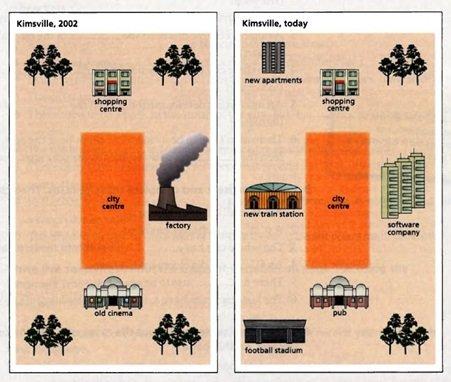
The maps bellow show recent changes in the town of Kimsville
A full IELTS Academic Writing Task 1 answer to this map at Band 6.0, 7.0, 8.5, with the four-part structure, the comparison language it needs, and why each version scores what it does.
The question
You should spend about 20 minutes on this task.
The maps bellow show recent changes in the town of Kimsville.
Summarise the information by selecting and reporting the main features, and make comparisons where relevant.
Write at least 150 words.
The town of Kimsville in 2002 and at the present day.
What to select from this map
Almost every change here follows the same pattern — an old industrial or leisure building giving way to a modern one on or near the same spot — so grouping the replacements together says more than listing buildings. The city centre, the shopping centre and the trees are unchanged, and stating that in one clause is what makes the changes stand out. Note the factory's smoke has gone with it, which is worth a mention.
Structure
Introduction — Paraphrase: what the two maps show and the two points in time.
Overview — No detail: the town has shifted from industry towards services and leisure, with the factory and cinema replaced and several new facilities added, while the centre itself is unchanged.
Body 1 — The replacements — factory to software company, cinema to pub.
Body 2 — The additions — apartments, train station and stadium — and what has stayed the same.
Model answers
Band 6.0 model answer
170 words
The two maps show the town of Kimsville in 2002 and today. We can see that there were several changes in this period.
In 2002 there was a factory on the east side of the city centre, and it produced a lot of smoke. Today this factory does not exist and in the same place there is a software company.
In the south of the town there was an old cinema in 2002. Today the cinema was replaced by a pub.
There are also some new buildings. In the north-west there are new apartments, and in the west there is a new train station. In the south a football stadium was built.
Some things did not change. The city centre is still in the middle of the map, the shopping centre is still in the north, and there are still many trees in the corners of the map.
In conclusion, Kimsville changed from an industrial town to a modern town with a software company, a train station and a stadium.
Why this is Band 6.0
All the changes are identified, which secures Task Achievement at this level.
Changes are listed one after another rather than grouped, and the passive is used only occasionally.
Vocabulary is adequate but repetitive: built, now and there is carry most of the meaning.
Prepositions of place are limited and sentence structures are mainly simple.
Band 7.0 model answer
189 words
The two maps compare the town of Kimsville as it was in 2002 with its layout at the present day.
Overall, the town has moved away from industry towards services and leisure. Two older buildings have been replaced by modern facilities and three entirely new ones have been added, while the centre of the town itself is unaltered.
The most significant replacement concerns the factory that stood immediately to the east of the city centre in 2002, complete with a chimney emitting smoke. This has been demolished and a software company now occupies the site, so the visible pollution has disappeared along with it. To the south, the old cinema has similarly given way to a pub.
Three facilities have been added where there was previously nothing. New apartments have been constructed in the north-west, a new train station has appeared on the western side of the city centre, and a football stadium has been built in the south-west corner. Elsewhere the town is unchanged: the city centre, the shopping centre to the north and the areas of trees around the edges have all been retained exactly as before.
Why this is Band 7.0
The overview is separate, arrives early and characterises the change as a shift from industry towards services and leisure.
Changes are grouped into replacements and additions, and the passive is used consistently.
Less common lexis is used accurately: demolished, replaced by, retained, facilities.
Prepositions of place are more varied: to the east of, in the south-west, adjacent to.
Band 8.5 model answer
239 words
The two maps compare the town of Kimsville in 2002 with its present-day layout.
Overall, the town has been transformed from a partly industrial settlement into one oriented towards services, transport and leisure. Two existing buildings have been superseded by modern replacements and three new amenities have been added, yet the core of the town — the city centre, the shopping centre and the surrounding woodland — remains exactly as it was.
The clearest transformation is the loss of the town's industry. In 2002 a factory occupied the area directly east of the city centre, its chimney shown emitting smoke; this has been demolished and a software company now stands on approximately the same footprint, so the pollution has vanished with the building. A comparable substitution has taken place to the south, where the old cinema has been replaced by a pub — in both cases an older facility giving way to a newer one on the same site rather than the town expanding.
Genuine expansion has occurred on the western and southern edges. A block of new apartments has been built in the north-west, a new train station now sits directly west of the city centre, and a football stadium has been constructed in the south-west corner, on land that was previously empty. Taken together with the retained features, the changes leave the shape of the town intact while altering almost everything about what it is used for.
Why this is Band 8.5
The overview names the character of the change — deindustrialisation and the arrival of transport, housing and leisure — rather than counting buildings.
Groups changes by type, so replacements and additions are handled as categories rather than in map order.
Notes the disappearance of the smoke as a consequence of the factory's removal, which reads the map rather than its labels.
Lexis is precise and economical: demolished, superseded, retained, footprint, amenities.
Complex structures are used flexibly, including a fronted concessive, an appositive and a participle clause, with no strain.
Model answers written and reviewed by The English All-in-One IELTS team. They are teaching models showing what each band looks like, not real candidate scripts.
This is a map question. The answers above show you what each band looks like when it is finished. What they cannot show you is how to get there from a blank page in forty minutes.
That is what our Writing Study Library is for: the structure we teach for this exact question type, the paragraph pattern that goes with it, and the sentence openers for each stage — so the essay is planned before you start writing rather than assembled as you go.
By type rather than by position. Separating replacements — where something was knocked down and something else built on the same spot — from genuine additions on empty land gives your paragraphs a purpose and reads far better than touring the map clockwise.
Should I mention details like the factory's smoke?
Yes, when they are drawn. The smoke is on the 2002 map and absent from the current one, so noting that it disappeared with the factory is reporting the diagram. It also demonstrates that you looked at the picture rather than only the labels.
What tense do I use if the second map says 'today'?
Present perfect passive for the changes — <em>has been demolished</em>, <em>has been built</em> — and past simple for the earlier state. This is the standard combination when a map runs from a past date to the present.
Is it worth saying what kind of town it has become?
A short characterisation in the overview is valuable, provided it follows from the buildings shown. Moving from a factory to a software company and gaining a stadium and a station supports a description of the change; speculating about the local economy would not.