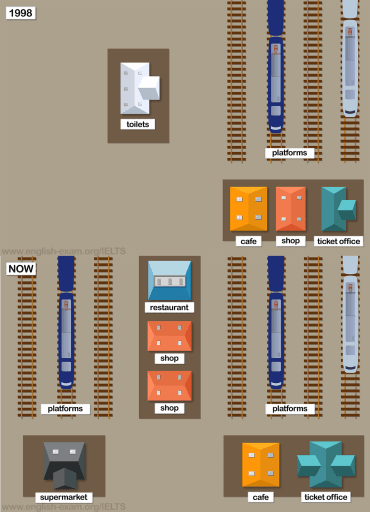
The maps show Pacific Railway Station station in 1998 and now
A full IELTS Academic Writing Task 1 answer to this map at Band 6.0, 7.0, 8.5, with the four-part structure, the comparison language it needs, and why each version scores what it does.
The question
You should spend about 20 minutes on this task.
The maps show Pacific Railway Station station in 1998 and now.
Summarise the information by selecting and reporting the main features, and make comparisons where relevant.
Write at least 150 words.
Pacific Railway Station in 1998 and at the present day.
What to select from this map
Maps are marked on the same criteria as charts, but almost all the language is different: you need the passive, prepositions of place, and vocabulary for construction, removal and replacement. The organising principle is not left-to-right but what happened — what was added, what was removed, what stayed. Notice too that the station has grown in both transport capacity and retail, which is the one-sentence summary the overview needs.
Structure
Introduction — Paraphrase: what the two maps show and the two points in time compared.
Overview — No detail: the station has been substantially expanded, gaining a second platform area and considerably more retail space, while the toilet block has disappeared.
Body 1 — Transport and the left of the site — the new platforms and the supermarket.
Body 2 — The retail buildings — the toilets replaced by a restaurant and shops, and the changes to the cafe block.
Model answers
Band 6.0 model answer
166 words
The two maps show the Pacific Railway Station in 1998 and at the present time. We can see that the station is much bigger now than before.
In 1998 there was only one area with platforms, on the right side of the station. Now there is a second area with platforms on the left side, so the station can receive more trains.
In 1998 there was a small building with toilets in the middle of the station. Today this building does not exist. In the same place there is now a restaurant and two shops.
In 1998 there were three buildings at the bottom: a cafe, a shop and a ticket office. Now there is still a cafe and a ticket office, but the shop was removed.
Another important change is that a supermarket was built in the bottom left corner, where there was nothing before.
In conclusion, the station has more platforms and many more places to buy food and other things than in 1998.
Why this is Band 6.0
All the main changes are identified, which secures Task Achievement at this level.
Changes are listed one after another with little grouping, and the passive is used only occasionally.
Vocabulary is adequate but repetitive: built, now and there is carry most of the meaning.
Prepositions of place are limited to on the left and near, and sentence structures are mainly simple.
Band 7.0 model answer
191 words
The two maps compare Pacific Railway Station as it was in 1998 with its present-day layout.
Overall, the station has been considerably enlarged, gaining a second set of platforms and a substantially expanded range of retail and catering facilities. The only feature to have disappeared entirely is the toilet block.
The most significant change concerns the station's capacity. In 1998 there was a single platform area with two tracks in the north-east of the site, whereas a second platform area has since been constructed on the western side, roughly doubling the space available for trains. In the south-west corner, an area that was previously empty, a supermarket has been built.
The retail buildings have also changed substantially. The toilet block that stood in the centre of the site has been demolished and replaced by a restaurant, with two shops added directly below it. The row of buildings to the south, which in 1998 consisted of a cafe, a shop and a ticket office, has been reduced to a cafe and a ticket office, the shop having been removed. In total, the number of retail outlets has risen from two to four.
Why this is Band 7.0
The overview is separate, arrives early and identifies expansion in both transport and retail as the main change.
Changes are grouped by area rather than listed at random, and the passive is used consistently for construction and removal.
Less common lexis is used accurately: demolished, replaced by, relocated, facilities.
Prepositions of place are handled with more range: adjacent to, to the left of, in the south-west corner.
Band 8.5 model answer
257 words
The two maps compare the layout of Pacific Railway Station in 1998 with its arrangement at the present day.
Overall, the station has been developed in two distinct respects: its capacity for trains has roughly doubled, and its commercial provision has expanded considerably. Only one feature has been lost outright — the toilet block — while the position of the platforms and the ticket office has remained unchanged.
The principal structural change is the addition of a second platform area. In 1998 the station operated with a single set of platforms serving two tracks in the north-east; a further platform area with two more tracks has since been constructed on the western side of the site, effectively doubling the number of trains that can be accommodated. The south-western corner, previously undeveloped open ground, is now occupied by a supermarket, which is the largest single building added.
Commercial facilities elsewhere have been reorganised rather than simply increased. The toilet block that stood at the centre of the site has been demolished and superseded by a restaurant, immediately beneath which two shops have been built. Meanwhile the row of buildings along the southern edge, which originally comprised a cafe, a shop and a ticket office, has lost its shop, leaving only the cafe and the ticket office in place. Taken together these changes represent a net gain of two retail units and one restaurant, alongside the supermarket — a marked shift from a station that offered little beyond a ticket office to one functioning partly as a shopping destination.
Why this is Band 8.5
The overview identifies the two dimensions of change — capacity and commercial provision — and notes the single removal, which frames everything that follows.
Grouping is by function rather than by position on the page, so each paragraph makes a coherent point about what the station became.
The passive is used throughout for changes, and location is specified precisely with compass directions and relative position.
Lexis is precise and economical: demolished, superseded, doubled its capacity, commercial provision, net gain.
Complex structures are used flexibly, including an absolute construction and a fronted adverbial, with no strain.
Model answers written and reviewed by The English All-in-One IELTS team. They are teaching models showing what each band looks like, not real candidate scripts.
This is a map question. The answers above show you what each band looks like when it is finished. What they cannot show you is how to get there from a blank page in forty minutes.
That is what our Writing Study Library is for: the structure we teach for this exact question type, the paragraph pattern that goes with it, and the sentence openers for each stage — so the essay is planned before you start writing rather than assembled as you go.
Use the present perfect passive for changes between a past date and now — <em>has been demolished</em>, <em>has been constructed</em> — and the past simple with the earlier map — <em>there was a toilet block</em>. If both maps are in the past, use the past passive throughout instead.
Should I describe the maps in order, or the changes?
Describe the changes. Going feature by feature through map one and then map two forces the reader to do the comparison, and comparison is the task. Group by what happened — what was added, removed, replaced — or by area of the site.
Do I need compass directions?
They are the clearest way to locate things and examiners expect some. If the map has no compass, relative position works equally well — <em>in the upper left</em>, <em>directly below</em>, <em>along the southern edge</em> — as long as you are consistent.
Is there an overview on a map task?
Yes, and it is just as important. Summarise the character of the change in one or two sentences — here, expansion in both capacity and retail with one feature lost — rather than beginning immediately with individual buildings.