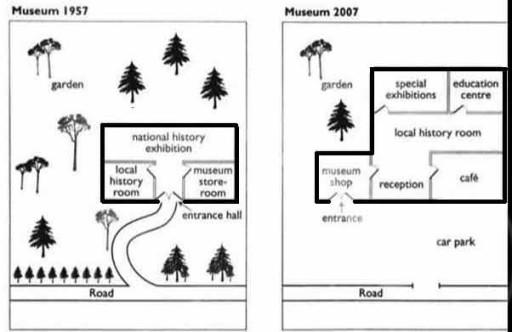
The maps illustrate the changes in the Local Museum at the north-east corner of Hartford Street and Redcliff Street in three separate years: 1957, 1987, 2007
A full IELTS Academic Writing Task 1 answer to this map at Band 6.0, 7.0, 8.5, with the four-part structure, the comparison language it needs, and why each version scores what it does.
The question
You should spend about 20 minutes on this task.
The maps illustrate the changes in the Local Museum at the north-east corner of Hartford Street and Redcliff Street in three separate years: 1957, 1987, 2007.
Summarise the information by selecting and reporting the main features, and make comparisons where relevant.
Write at least 150 words.
The Local Museum at the corner of Hartford Street and Redcliff Street in 1957 and 2007.
What to select from this map
The building has both grown and changed purpose, and separating those two things gives the answer its structure. Notice what disappeared: the store-room and the national history exhibition are gone, replaced by visitor facilities — a café, a shop, a reception — which says the museum has shifted from storing and displaying towards receiving visitors. The loss of the trees to a car park is the other reportable change.
Structure
Introduction — Paraphrase: what the two maps show and the two dates.
Overview — No detail: the museum has been substantially enlarged and reoriented towards visitors, gaining facilities and a car park while losing its store-room and its surrounding trees.
Body 1 — The building — what was there in 1957, what was removed and what was added.
Body 2 — The grounds and access — trees replaced by a car park, and the entrance relocated.
Model answers
Band 6.0 model answer
202 words
The two maps show a local museum in 1957 and in 2007. The museum became much bigger during these fifty years.
In 1957 the building was small. It had an entrance hall in the middle, a local history room on the left and a museum store-room on the right. Above these rooms there was a national history exhibition.
Around the building there were many trees, and there was a garden on the west side. Two paths went from the road to the entrance hall.
In 2007 the building is much bigger. The national history exhibition does not exist anymore, and now there are special exhibitions and an education centre in the north. The local history room is still there but it is bigger.
There are also new rooms for visitors: a museum shop, a reception and a café. The entrance is now on the west side, not on the south side.
The trees around the museum were cut down, and now there is a big car park in the south-east. Only the garden and a few trees on the west side did not change.
In conclusion, the museum became bigger and more comfortable for visitors, but it lost most of its trees.
Why this is Band 6.0
All the main changes are identified, which secures Task Achievement at this level.
Changes are listed one after another rather than grouped, and the passive is used only occasionally.
Vocabulary is adequate but repetitive: built, now and there is carry most of the meaning.
Prepositions of place are limited and sentence structures are mainly simple.
Band 7.0 model answer
246 words
The two maps compare a local museum at the corner of Hartford Street and Redcliff Street as it was in 1957 and as it appeared in 2007.
Overall, the museum has been considerably enlarged and its purpose has broadened. Alongside its exhibition space it now provides a range of visitor facilities, while the wooded grounds that once surrounded it have largely been given over to parking.
In 1957 the building was small and simple, consisting of an entrance hall approached by two paths from the road, with a local history room to its west and a museum store-room to its east. A national history exhibition occupied the northern part of the building. By 2007 both the store-room and the national history exhibition had gone. In their place the museum had gained a special exhibitions area and an education centre along the northern edge, while the local history room had been enlarged to occupy the whole central section.
Visitor facilities account for much of the remaining new space: a reception has been created in the middle of the southern side, with a café to its east and a museum shop to its west. Access has also been altered, the entrance having been relocated from the south to the western side of the building. Outside, the trees that covered the eastern part of the site have been cleared to make way for a large car park, although the garden and some trees to the west have been retained.
Why this is Band 7.0
The overview is separate, arrives early and identifies both the enlargement and the shift towards visitor facilities.
Changes are grouped into the building and the grounds, and the passive is used consistently.
Less common lexis is used accurately: extended, relocated, facilities, retained.
Prepositions of place are more varied: to the north of, along the eastern side, adjacent to.
Band 8.5 model answer
287 words
The two maps compare the Local Museum on the corner of Hartford Street and Redcliff Street in 1957 and in 2007.
Overall, the museum has been substantially extended and reoriented towards its visitors. Space previously used for storage and for a permanent national exhibition has been replaced by a café, a shop and a reception, while the wooded grounds have been largely surrendered to a car park.
The 1957 building was modest, comprising an entrance hall reached by two winding paths from the road, flanked by a local history room to the west and a museum store-room to the east, with a national history exhibition across the northern side. By 2007 the footprint had expanded considerably and its internal arrangement had changed entirely. Both the store-room and the national history exhibition had disappeared; in their place the northern edge now holds a special exhibitions gallery and an education centre, while the local history room has been enlarged to run across the whole centre of the building.
The southern side is given over almost wholly to facilities that did not exist before — a reception in the centre, a café to the east and a museum shop to the west — and the entrance has been relocated from the south of the building to its western side, beside the shop. Taken together with the loss of the store-room, this indicates a museum reorganised around receiving the public rather than housing a collection.
Outside, the change is equally marked. The trees that once covered the eastern half of the site have been cleared to accommodate a large car park occupying the whole south-eastern corner, though the garden and a small group of trees on the western boundary survive unchanged.
Why this is Band 8.5
The overview names both the enlargement and the change of purpose, and identifies what was given up to achieve it.
Groups the changes by function — display space, visitor facilities, grounds and access — rather than touring the map.
Notes that the store-room's removal and the café and shop's arrival together indicate a shift from storage towards public use.
Lexis is precise and economical: extended, relocated, given over to, footprint, reoriented.
Complex structures are used flexibly, including a fronted concessive, an appositive and a participle clause, with no strain.
Model answers written and reviewed by The English All-in-One IELTS team. They are teaching models showing what each band looks like, not real candidate scripts.
This is a map question. The answers above show you what each band looks like when it is finished. What they cannot show you is how to get there from a blank page in forty minutes.
That is what our Writing Study Library is for: the structure we teach for this exact question type, the paragraph pattern that goes with it, and the sentence openers for each stage — so the essay is planned before you start writing rather than assembled as you go.
Use compass directions or relative position — "along the northern edge", "to the west of the reception" — and say what replaced what rather than listing rooms. On an interior map the reader needs to know where things are in relation to each other, not just that they exist.
Is it worth saying what the changes suggest about the museum?
A short characterisation is valuable if it follows from the rooms shown. Losing a store-room while gaining a café, a shop and a reception genuinely indicates a shift towards visitors. Speculating about funding or attendance would not.
Should I mention things that disappeared?
Always. Removals are as reportable as additions, and an answer that lists only the new rooms leaves the reader unsure whether the old ones survived. The national history exhibition and the store-room are both gone, and saying so is part of complete coverage.
How much detail do I give about the paths and the entrance?
Enough to note the change in access. The entrance moving from south to west alters how visitors reach the building, which is a genuine feature; describing the exact curve of the 1957 paths is detail that earns nothing.