
Table Task 1 Academic

J. The table below shows the expenses of a used bookstore in Scotland for the first and last month of the same year

A full IELTS Academic Writing Task 1 answer to this table at Band 6.0, 7.0, 8.5, with the four-part structure, the comparison language it needs, and why each version scores what it does.

The question

You should spend about 20 minutes on this task.

J. The table below shows the expenses of a used bookstore in Scotland for the first and last month of the same year.

Summarise the information by selecting and reporting the main features, and make comparisons where relevant.

Write at least 150 words.

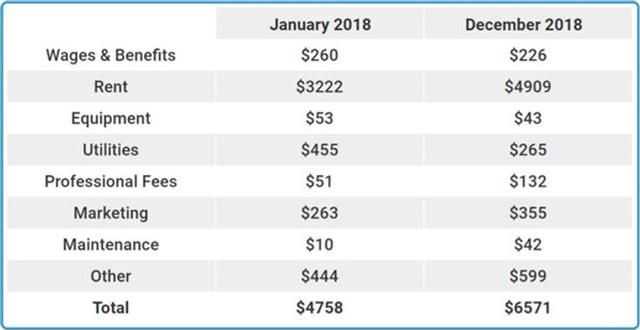
Table of a Scottish used bookstore's expenses in January and December 2018. Rent rises from $3,222 to $4,909 and dominates both months. Marketing rises from $263 to $355, professional fees from $51 to $132 and maintenance from $10 to $42, while wages fall from $260 to $226, utilities from $455 to $265 and equipment from $53 to $43. The total rises from $4,758 to $6,571.
Expenses of a used bookstore in Scotland in the first and last month of the same year.

What to select from this table

One line dominates everything: rent is around two thirds of the total in January and three quarters by December, so its increase alone accounts for most of the rise in overall costs. Establishing that first prevents the answer becoming a list of eight small numbers. The other point worth making is proportional — maintenance quadrupling from $10 to $42 is the largest relative change but almost irrelevant to the total.

Structure

Introduction — Paraphrase: whose expenses, which two months, and that totals are given.

Overview — No figures: total expenses rose substantially, driven almost entirely by rent, which dominated both months; several smaller categories fell.

Body 1 — Rent and the total — how much of the increase rent accounts for.

Body 2 — The remaining categories, grouped into those that rose and those that fell, with the proportional point about the smallest items.

Model answers

Band 6.0 model answer

131 words

The table shows the expenses of a used bookstore in Scotland in January 2018 and in December 2018.

The total expenses increased from $4,758 in January to $6,571 in December. The biggest expense in both months was rent. In January it was $3,222 and in December it increased to $4,909.

Some other expenses also increased. Marketing increased from $263 to $355, professional fees increased from $51 to $132, and maintenance increased from $10 to $42.

Other expenses decreased. Wages and benefits decreased from $260 to $226, utilities decreased a lot from $455 to $265, and equipment decreased from $53 to $43.

The category 'other' also increased, from $444 to $599.

In conclusion, the shop spent much more money in December than in January, mainly because the rent became much more expensive.

Why this is Band 6.0

  • All eight categories and both totals are covered accurately, which secures Task Achievement at this level.
  • The table is read row by row rather than grouped, so the dominance of rent is stated late.
  • Vocabulary is adequate but repetitive: increased, decreased and dollars recur throughout.
  • Sentences are mainly simple and compound, with one figure per clause.

Band 7.0 model answer

190 words

The table compares the expenses of a used bookstore in Scotland in the first and last months of 2018.

Overall, the shop's total outlay rose considerably over the year, and almost all of that increase is attributable to rent, which was by far the largest single cost in both months. Several of the smaller categories actually fell.

Total expenses climbed from $4,758 in January to $6,571 in December, an increase of $1,813. Rent alone rose by $1,687 over the same period, from $3,222 to $4,909, meaning it accounted for well over nine tenths of the overall increase. Its share of the total also grew, from around two thirds of expenses in January to roughly three quarters in December.

Among the remaining categories, three rose and three fell. Marketing increased from $263 to $355, professional fees from $51 to $132, and maintenance from $10 to $42, while the miscellaneous 'other' category grew from $444 to $599. Against these, utilities dropped sharply from $455 to $265, wages and benefits eased from $260 to $226, and equipment from $53 to $43. All of these movements were small in absolute terms compared with rent.

Why this is Band 7.0

  • The overview is separate, arrives early and identifies rent as the driver of the overall increase.
  • Categories are grouped by direction of change rather than read down the table.
  • The share of the total taken by rent is calculated, which no single cell shows.
  • Less common lexis is used accurately: outlay, accounted for, overheads, marginal.

Band 8.5 model answer

273 words

The table compares the expenses incurred by a used bookstore in Scotland in January and December of the same year, together with monthly totals.

Overall, total expenditure rose by well over a third across the year, and this was almost entirely the result of a single item: rent, which dominated the accounts in both months and grew steadily more dominant. Most of the other categories were small enough that their movements had little effect on the total, and several of them fell.

Total outlay increased from $4,758 to $6,571, a rise of $1,813. Of that, $1,687 came from rent alone, which climbed from $3,222 to $4,909 — so rent accounted for roughly 93 per cent of the entire increase. Its dominance also deepened: having represented about two thirds of monthly expenses in January, it made up close to three quarters by December, meaning every other cost combined shrank as a proportion of the whole.

The remaining categories divide evenly. Marketing rose from $263 to $355, professional fees from $51 to $132, maintenance from $10 to $42, and the residual 'other' category from $444 to $599. Offsetting these, utilities fell substantially from $455 to $265, while wages and benefits and equipment both declined modestly, to $226 and $43 respectively.

It is worth noting that the largest proportional change in the table is not rent at all: maintenance more than quadrupled. In absolute terms, however, that amounts to $32, so it is negligible beside a rent increase more than fifty times its size — a reminder that on a table of this kind the biggest percentage and the biggest effect are rarely the same figure.

Why this is Band 8.5

  • The overview identifies rent as effectively the whole story and says so before any figures, which frames everything that follows.
  • Quantifies rent's contribution to the total increase and its growing share, both of which require reading the table rather than transcribing it.
  • Distinguishes proportional from absolute change, noting that the largest relative rise is also the least consequential.
  • Lexis is precise and economical: outlay, attributable to, overheads, negligible, offset.
  • Complex structures are used flexibly, including a fronted concessive, an appositive and a participle clause, with figures embedded naturally.

Model answers written and reviewed by The English All-in-One IELTS team. They are teaching models showing what each band looks like, not real candidate scripts.

This is a table question. The answers above show you what each band looks like when it is finished. What they cannot show you is how to get there from a blank page in forty minutes.

That is what our Writing Study Library is for: the structure we teach for this exact question type, the paragraph pattern that goes with it, and the sentence openers for each stage — so the essay is planned before you start writing rather than assembled as you go.

See the structure for this question type →

Vocabulary for this topic

Word or phraseMeaningUsed in a sentence
outlaythe total amount of money spentTotal outlay increased from $4,758 to $6,571.
attributable tocaused by or accounted for byThe increase is almost entirely attributable to rent.
to account forto make up a stated share of a totalRent accounted for 93 per cent of the increase.
overheadsthe regular running costs of a businessRent is the largest of the shop's overheads.
to offsetto cancel out, at least partlyFalling utilities partly offset the rise in marketing.
negligibletoo small to matterA $32 rise is negligible beside the rent increase.
residual categorya group covering everything not listed separatelyThe residual 'other' category grew to $599.
to quadrupleto become four times largerMaintenance more than quadrupled.

Write your own answer

Draft your response below, then get it marked against all four IELTS criteria. Your draft stays in this browser — nothing is published.

Common questions

How do I handle a table where one figure dwarfs the rest?

Lead with it and quantify its effect. Saying that rent produced 93 per cent of the total increase tells the reader more than eight separate comparisons would, and it justifies covering the smaller categories briefly rather than one by one.

Is a rise from $10 to $42 worth mentioning?

Worth mentioning, but with its scale made clear. It is the largest proportional change in the table and the smallest in cash terms — a contrast that is genuinely interesting and demonstrates you can distinguish the two measures rather than reporting whichever looks bigger.

Should I calculate percentages from the table?

Simple ones add real value here, because the totals are given: rent as a share of the total, or its share of the increase. Keep them approximate and only attempt arithmetic you can do reliably in exam conditions.

Do I need to explain why the expenses changed?

No. The table gives two months and no context, so any explanation for the rent rise would be invention. Report the pattern and its scale, and leave it there.